|
1 January, 2012
Hyderabad
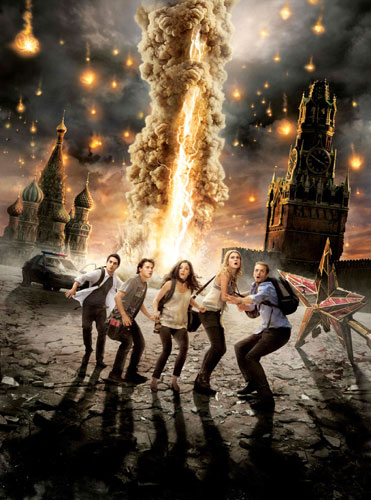
THE DARKEST HOUR
THE DARKEST HOUR is the story of five young people who find themselves stranded in Moscow, fighting to survive in the wake of a devastating alien attack. The 3D thriller highlights the classic beauty of Moscow alongside mind-blowing special effects from the minds of visionary filmmaker TimurBekmambetov ( Wanted , Night Watch ) and director Chris Gorak ( Right At Your Door ).
Arriving amidst a mysterious lightening storm, young Internet entrepreneurs Sean (Emile Hirsch) and Ben (Max Minghella) land in the vibrant Russian capital to pursue their business dreams in the international economic center, full of new money but unscrupulous business practices. Travelers Natalie (Olivia Thirlby) and Anne (Rachael Taylor), stranded in Moscow by an unscheduled stop over en route to Nepal, make the best of it by seeking adventure in one of the nightlife capitals of the world.
The two pairs of best friends meet amid the glitz and glamour of the Zvezda Nightclub, the hot spot for the international and the beautiful in Moscow, including the young turk Skylar (Joel Kinnaman), the Swedish businessman who duped Sean and Ben. A mecca for the globe trotting youth, supermodels, and business elite congregating in Moscow, the club is quickly transformed to a scene of terror when the aliens invade and everything goes dark.
After surviving the initial attack hiding underground, days later the five emerge into the confines of a Moscow that's become increasingly alien – the once pulsating city is now without power and is all but deserted, yet occupied by a force they don't understand. Made up of electromagnetic wave energy, the alien beings kill brutally by shredding earthly life forms, reducing those in their way to their molecular structure instantly. The aliens are also basically invisible to humans, however anything electrical gives them away. Daytime is now dangerous, so the survivors learn to travel across the city in the safety of night, while confronting their individual reactions to these extraordinary circumstances where everything familiar is gone.
Throughout their journey across a foreign city to find help, the dwindling band encounter various Russian survivors who help them start to unravel the mysteries of the near-invisible invaders, their goals and weaknesses, and most importantly, how to fight back.
Courage survives.
A co-production between New Regency and Summit Entertainment, The Darkest Hour is directed by Chris Gorak from a screenplay by Jon Spaihts, based on a story by Leslie Bohem& M.T. Ahern and Jon Spaihts. Emile Hirsch ( Into The Wild, Milk, Speed Racer ); Olivia Thirlby ( Juno ); Max Minghella ( The Ides of March, The Social Network, Agora ); Rachael Taylor ( Transformers ); and Joel Kinnaman ( Snabba Cash , AMC's “The Killing”) star. Tom Jacobson ( Ladykillers, Mission To Mars ) and TimurBekmambetov (director of Wanted ) produce. Monnie Wills is the executive producer. Summit Entertainment releases the action-thriller theatrically in North America on December 25, 2011. 20 th Century Fox distributes internationally.
The Darkest Hour is in Reel D 3D & 2D theatres on Christmas Day 2011.
* * *
ORIGIN OF THE PROJECT – ALIENS IN MOSCOW
The Darkest Hour began as the seed of an idea often discussed by producer Tom Jacobson and executive producer Monnie Wills. “About five years ago, we were talking about what would it be like to survive in the wake of an alien apocalypse where we lost?” explains Jacobson. “What happens the day after Independence Day ? We were interested in a story that is focused just on the characters. Where were they? I like stories about humanity and science fiction, with the classic themes such as ordinary people in the midst of extraordinary circumstances. What would happen if we were attacked, conquered, and occupied? That was the genesis of the idea.”
“I also like the notion of people in an occupied territory who don't capitulate, like French resistance movies,” adds Jacobson. “So this is also somewhat inspired by those great World War II movies, except instead of German lines, we're behind enemy lines of an alien occupation. That whole genre allows you to explore heroism and how you behave when you're tested. In a theatrical world, the best science fiction can heighten those themes and therefore is very entertaining to an audience.”
Jacobson turned to his old friend Leslie Bohem, and his young writing partner,
M.T. Ahern, to flesh out the concepts. “They took that shred of the idea, invented the story, and came up with the title The Darkest Hour ,” says Jacobson. “It then evolved in a lot of different directions. Les and Megan wrote a really great story about human survival, which I sold to New Regency, and then the thought came up of adding a surprising and unique element to it. Through all of these science fiction or war narratives, we've seen versions of everything, so let's add an original layer.”
“A big decision was made. From page one, let's set it in Moscow,” reveals Jacobson. “This is one of those huge ideas that changed everything… who the characters were and why would we be in Moscow. They come to this exciting vibrant city that a lot of people have heard about, but most people, especially most Americans, haven't been there. Moscow seemed like the type of place that young characters might adventure to,” says Jacobson. “We were all excited by making it about a group of people who are already strangers in a strange land, and when the aliens come, just became even stranger.”
Screenwriter Jon Spaihts began work on a whole new script set in Moscow and Moscow-based filmmaker TimurBekmambetov, who directed the global hits Wanted and Night Watch , joined the project as a producer. “Partnering with TimurBekmambetov was very exciting because he loved the science fiction and visual elements of the movie,” says Jacobson. “Plus Timur has an insider's view of filmmaking in Moscow.”
The groundbreaking director was happy to participate as a producer. “Producing and directing for me, is almost the same. When you're directing, you're not shooting, you're not acting yourself, you're not dressing actors… you're directing,” explains Bekmambetov. “The producer is also managing processes - people and expectations - so for me to produce means you have the movie in your head and you have to find the right people to make it. It's almost the same thing. You're not screaming rolling on the set, but you're still finding the right people and the right strategy.”
“Originally, maybe 4 years ago, it was scripted in a small American town. The first time I spoke with Tom Jacobson, I said ‘Can we move it to Moscow?' When you change the point of view it becomes an interesting project immediately. Like King Kong in Moscow would be a big deal, King Kong in New York nobody wants to play that game because it's been done,” comments Bekmambetov. “It's still quite intriguing for the viewer to be here because not so many western movies are made in Moscow. It makes the movie cool immediately.”
“Moscow is a unique environment and very interesting visually because it's unusual. Moscow is not as pretty as Paris, not as big as Manhattan, but it has it's own tone and light. If you move any conventional, classic story to Moscow, it immediately becomes something interesting,” reiterates Bekmambetov. “Second, we have the Russian culture, we have history of Russian filmmaking that's different, and somehow it's influenced the movies made in Russia. The audience will enjoy it and will feel it's something new. The formula of a successful project has to be relatable story in a unique world. If you have a good story and you can shoot it in Moscow, then you have an interesting film, like District 9 in Johannesburg, South Africa.”
“The location itself became part of the storytelling power,” adds Jacobson. “Visually Moscow has force and power in the architecture that we wanted to capture, and we see it through a foreigner's point of view. Moscow also has a reputation as a wild place, with a lot of nightlife and a lot of money. We also wanted to capture that new Wild West feeling here… the excitement, gloss, glamour, noise, music, and dynamism of the city… and then contrast that with the silence after the fall.”
“Timur has this fantastic vision and imagination, but he also has this great group of people working with him at his company Bazelev who are doing a lot of our visual effects. Very early we started visual development and they did a lot of concept art and animatics – or pre-viz – of key elements,” explains Jacobson. “The movie was about the idea and then about the visualization and execution of the idea. So Timur's visual effects team in Moscow started the work almost two and a half years before shooting and generated a lot of images that gave a sense of the movie.”
“They created early concepts of the aliens and a general proof of concept look of a depopulated Moscow, because that was one of the big elements, to take a huge international city of 14 million people and empty it,” adds Jacobson. “Later in the movie, the characters also discover the aliens are doing something here. There are manufacturing works and we came up with the designs for those alien towers. This early concept art was a palate of opportunity for the director, who started guiding that work when he started on the movie.”
About a year before shooting began, director Chris Gorak was selected to helm the project. “I was excited to get in business with Chris because I loved his movie Right At Your Door . I thought it was authentic, sincere, scary, believable, the actors were great in it, and the story was told with conviction,” says Jacobson.
“Chris read our script, was interested, and everything he said about it felt right and then some. Specifically about certain areas of the storytelling, like how the characters move through the story. Chris felt their journey of realization was really important… what they learn about the aliens and about their own circumstances drives the emotion of the story. The window into story is through our characters. The narrative point of view of the movie is to follow them as they figure out what's going on,” explains Jacobson.
“ The Darkest Hour is only his first time directing, but Chris has really brought something interesting because he really comes with a true focus on character,” agrees Wills. “He really spent a lot of time thinking about and working with the actors about their experiences here… what it means to be in Moscow and to really make these characters come alive. Chris also comes from a production design and art director background, so he's really been able to stage the film to not only take advantage of Moscow, but to put our characters into the middle of a very believable, post-apocalyptic city.”
“Since I'm very comfortable with the visual aspects of filmmaking, I can focus on script, character, and telling the right story, and the other stuff is second nature,” says Gorak. “But Moscow was one of the first things that I got really excited about. First was the alien and how it interacted with our world, but second was Moscow itself as a location. The city added a whole other texture and character in the film that's irreplaceable.”
“Historically Moscow is a stand-alone culture and in an area of Europe that really is like the last frontier. We wanted to put our group of travelers in a place where it's unbalanced for them. Moscow is that plus it offers so much richness and density,” says Gorak. “In addition, Russian is a foreign language for everyone in the movie. Moscow is this island of opportunity for a young westerner, yet they can't read a street sign because they are written in the Cyrillic alphabet, so they don't know which way to go. That creates a fish out of water survival story.”
“There have been so many alien invasion films and Moscow gave a fresh layer to the concept. I have never been here before, and now I'm here destroying it,” laughs Gorak. “I was really excited to explore Moscow and find all the iconic locations, work with the team here, and build a version of Moscow that has never been seen before.”
“It was very important for Chris to actually take a journey as a filmmaker as he was prepping the movie, to learn the city and pick the places that he felt had power that would impact the characters standing in front of something very massive, powerful and beautiful, and sometimes beautiful in a brutal way. Hopefully, in the same way it will impact the audience,” adds Jacobson.
“When we were scouting for locations, the Russian crew was a little resistant to my wanting to shoot all the iconic places that I've never seen in an American film. To them picking Red Square is like us shooting the Statue of Liberty, Times Square, or the Hollywood sign. But I wanted all the postcard shots and I wanted to put out characters and our story inside that postcard. I wanted Red Square, the Patriarch Bridge, the Church of Christ… all this really iconic Russian architecture. All this stuff that makes up Moscow, makes it so rich and so vibrant. Learning about the history as we were filming was just incredible and I knew it was going to add so much texture that a large majority of this audience would never experience in person, never mind in an alien invasion film.”
Jacobson adds, “Chris obviously has a great eye and a great vision. His visual skill set was this incredible bonus that you see in the movie, especially the locations. When we came to Moscow, it's like any huge international city - Rome, Paris, London, New York – in that it's a hard city to shoot because it is huge and has civic rules. Chris really challenged the production because he wanted to shoot an international movie in a narrative way by putting the characters and the story into these backgrounds to make it feel real. He wanted to shoot Moscow in a way that hasn't been seen before.”
The director's energy helped keep the challenging location shoot together. “Chris Gorak has not stopped moving since the day that he landed in Moscow,” laughs Wills. “There's no one on our crew that is working harder and that leadership from a director really encourages the rest of the crew to step up. We have a limited amount of time that we can be in these locations and a lot that we want to get, so every second counts. It makes a difference when your director is leading the charge.”
Gorak was particularly attracted to the unique take on the science fiction parts of the story. “The content was really interesting. Being a science fiction cinema fan, when I first got the script for this project I was attracted to this idea of the apocalypse, but mostly to what the aliens are,” shares Gorak. “I was really attracted to their invisible nature and the unique concept of how they affect the electricity of the environment. I felt a great challenge in how to present that cinematically.”
“The deadly nature of these aliens comes from the fact that they are, for the most part, invisible. When they strike it's instant, deadly, and irreversible. The big idea is that they are electrical creatures, which is something the characters discover along the way,” says Jacobson. “Even though it is science fiction logic, we wanted it to be credible. So we spent a lot of time, especially when Chris Gorak came on, embedding the science. These are creatures of some combination of mechanical and electromagnetic, and their blood is electricity. We came up with this concept that they generate this shield that renders them invisible. That shield has a dual purpose - a defensive and an offensive weapon.”
After hiding through the initial attack, the main characters emerge and begin searching for other survivors. “The creatures have blasted the entire planet into the Stone Age. There's no electricity, no phone works, nothing… it's the Dark Ages. Our characters don't know what has happened,” states Jacobson.
The survivors travel across a deserted Moscow to find help, all the while trying to evade the enemy. “The aliens send out a wave energy that ripples through the environment and ignites everything that conducts electricity. That's how it searches and sees. It's not x-ray, it's not infrared… it's something new,” adds Gorak.
“I was really excited that his project flips the terror genre on its head… light is more dangerous than dark,” explains Gorak. “In this genre, dark is usually the scariest, but now because the aliens are invisible yet illuminate lights as they come near, the light bulb becomes a marker of danger. So it's actually safer to travel at night, avoid the light and stay in the darkness. Daytime is now scary.”
“The aliens' interaction with lights, any electrical device, creates this reverse scare, because normally light is safety. But in our movie, it means that danger is coming,” agrees Jacobson. “When an alien is near that light, it'll flicker on, without any connection to any power source, because the alien itself generates that power. The characters figure this out for themselves, and they then start to smartly think of light bulbs or radios or flashlights or cell phones as early warning devices.”
The aliens' weapon of choice is the shred. “One of the great aspects of our enemy is that they have this very violent attack protocol. The aliens shred human beings with an instant cauterization of our particles… ashing the body into dust. The shred is a very violent, organic and sloppy process, and it's never perfect. No two shreds are the same,” explains Gorak. “It's grounded in physics and that grounds the movie, making for a real danger for our audience to experience. “
“Shredding is like a wood chipper or a belt sander,” adds Jacobson. “It all comes back to the concept that it's electrical in nature, so the shredding is more like being disintegrated by a bolt of lightning. Since we wanted to go for a PG-13 rating, there was a lot of visual development on the intensity of the shred. We wanted to have an adventure feel, as opposed to a straight horror feel. We didn't want it to be gory, we wanted it to have a science base.”
The audience sees the aliens' point of view when it is hunting survivors. “In the original script there was no point of view (POV) of the alien, that was an element that Chris Gorak brought. We started to realize that when you're dealing with something invisible, you need to signal to the audience some threat. Where is this thing? By giving it a POV, we really clued into this idea that there is an intelligence there, that humans are being hunted; this isn't just some random occurrence. There's a thinking breathing something that is after our people. These aliens are not seeing your heat signature or your bones, they're actually seeing the electrical pulses that move through your body, emanating out of the brain and down the spine. Once we hit on that idea, it just fell into place.”
Bekmambetov offered practical and creative guidance to Gorak in prepping the shoot, but did not spend a lot of time on the Moscow set once the cameras rolled. “I'm trying to stay away from the set,” admits Bekmambetov. “It's quite a unique experience, because I've never before been a producer of an American movie. I'm trying to protect Chris, to let him play his own game and be creative. I can help him to understand Russian realities and to be sure this movie will be correct emotionally for Russian audiences. We spent a lot of time with the Russian visual effects people here to develop pre-visualizations and art concepts and I was helping to make it happen. As a producer, I never planned or wanted to direct it. This is a story about American kids in Moscow… it's better that Chris will tell the story, because he is an American kid in Moscow.”
“Timur and his team have been fantastic collaborators throughout the process. Early on, Tom, Monnie and I meet with Timur at his house in Los Angeles and had creative sessions that were really productive,” says Gorak. “Timur is an incredible creative filmmaker in his own right, and he added touches to our alien design, movement, and activity. Their subtle existence and dangers of the alien and how to present that to the audience.”
Gorak continues, “Timur always adds that little touch to make it special… he's really good at that. What was the enemy and what were the rules of the enemy. Timur likes to police the mythology of the science fiction. What are these aliens, what are they made up of, what do they want? We had a lot of discussions about that, which then leads to those fun moments in the story for example, of scattering light bulbs as a warning device. Those kinds of moments that Timur adds can become classic indelible images.”
Jacobson adds, “It's been a really good combination because Chris brings this really grounded reality to put our character in, and our partnership with Timur brings a theatricality and a flash. Certainly his producing of this inside Moscow has been incredibly helpful. Timur's work brings us dynamics and imagination to this very original vision.”
During the development of The Darkest Hour , James Cameron's groundbreaking 3D film Avatar was released to overwhelming critical, financial, and creative success. “Originally The Darkest Hour was a 2D movie in my head, but when Avatar came out, the studios started really thinking about which properties could be 3D. So in the spring of 2010 we shot some 3D tests in Los Angeles to see how 3D fit with what we were trying to create. Quite honestly I was reluctant because I had a different film in my head for so long. Once we played with the 3D equipment, cut that test night shoot together, worked with it in post putting in some visual effects, and projected in on screen… I just changed,” admits Gorak.
“Going 3D was quite ambitious because it costs more money,” adds Bekmambetov. “It was a very brave decision to shoot in 3D and not convert later, because it changed the whole production plan and made us rethink all these shots. The choreography of the 3D shots is another language from a 2D movie. It's the beginning for 3D and some of this language doesn't exist yet. Every new 3D movie, it is one step forward to develop this language. We have to learn how to do this, but also we have to teach audiences how to consume, because it's very different. But it's good because we have a chance to play with these new toys and figure out how it works.”
“We chose to shoot 3D to really capture one, the environment of this incredible city, and two our alien itself and the way it behaves and shreds. We thought the electrical nature of the aliens would be fantastic in 3D. To us, Moscow is the new Pandora. To be the first film to shoot 3D here is a great opportunity that we didn't want to miss,” shares Gorak.
“When you commit to shooting a film in 3D, you want to deliver a level of experience that you're just not going to get in 2D, or else what is the point?” asks Wills, “The ability to project the ash out into the audience was something that we keyed in on very early and wanted to make a part of that 3D experience.”
“Shooting in 3D has an immersive quality to it. I like to call it innovative dynamic immersion, or IDI. It's not about 3 dimensions… it's about four, five, or six dimensions. It's HD on steroids where you're in the environment and the environment is shaped in a different way for the viewing audience. Grabbing the characters and sticking them in the lap of the audience, and grabbing the audience and sticking them in the environment is what it's about,” says Gorak.
“The movie is going to be a real strong emotional and thrilling ride. Once our characters come out of their shelter and try to find their way across the city, it's pretty relentless. Chris and our director of photography Scott Kevan specifically designed shots with a lot of depth behind the characters so you'll feel like you're there, like you're in it,” describes Jacobson. “It's a natural for this movie to be 3D because the story has an adventure quality and a journey part to it - those elements play really well in 3D. We're also trying to shoot in this naturalistic action way that we don't think has been done a lot in 3D. You've seen grand fantasy science fiction movies, family movies, and video game movies shot in 3D, but we haven't really seen a grounded adventure movie in 3D yet.”
Just prior to the start of filming, acclaimed visual effects supervisor StefenFangmeier joined the creative team. “Timur was instrumental in developing some of the early concepts - the way that we could define the aliens movement by being electric, lighting the things around it, the shred, and some of the lightening that it shoots. But when it came time to actually execute that, Stefen has been very instrumental in helping us to really integrate the production into those visual effects. It's very important that it not feel too CG. It needs to feel like it is really happening,” says Wills.
“Stefen's input on the film is priceless,” states Gorak. “He added a great level of creativity and detail to the film that comes from his years of experience and his experience as a director. He had some great suggestions, not only on set, but also in post as we developed the alien further and how an alien would come towards the camera in 3D.”
Jacobson comments, “Stefen helped with how to embed those visual effects in the movie to achieve this combination of reality that we wanted. This is taking place in the real world, but also should have scale and have a grounded wow factor - we wanted to feel like it's really happening to these people. The alien itself, the alien action, the alien towers, and the way the aliens land, all have some spectacle to it, but in this real world.”
“When we started working with Timur, he had this very talented team at Bazelev led by visual effects supervisor Dmitry Tokoyakov, who was really guiding this, and then along the way StefenFangmeier came and they made a fantastic team,” adds Jacobson.
“Stefen and Dmitry bring a real understanding of what this could be,” agrees Gorak. “There's a very subtle nature to the design of this creature where the alien isn't revealed on page one. There is a long reveal of what the alien is, how much you see of this alien, and how our heroes start to understand it. Once they understand the physics of this alien, they can start to fight back. Our journey takes us through that understanding and I feel Stefen and his team fully grasped that and how to hide the ball.”
“The 3D helps to create these epic stages for an intimate story. The core is the relationship between people, that's a dramatic spine of the movie, what makes the movie emotional,” says Bekmambetov. “But the scope gives you the scale and the background. This is very unique because the 3D makes the experience about being there. I hope this movie will give audience a chance to literally feel what's happening when a huge disaster happens. It's the first movie when you see the world destroyed in 3D.”
Shooting in 3D makes the job of the actors even more crucial. “It's very important to be connected with these characters because in a 3D movie you cannot cut and force the viewer's attention, you can't shake him, and you have to let him be there with the characters. Thankfully, we have great actors.”
“The modern movie-going audience is thirsty for something that they haven't seen before. But they're not going to care if they're not connected to the characters going through the experience,” agrees Wills. “First and foremost for us was to really connect this character journey to the audience and then let the experience that they're having with the aliens, the visual effects, and the 3D inform and complement that, but not to overpower it.”
CASTING
Five dynamic young actors were cast to play the survivors the audience follow through the story. “The script characterized a group of young people who were the age and type of contemporary people who would end up in Moscow. We really wanted these characters to feel authentic, dramatic, fun and relatable so we are thrilled with the cast we ended up with, who feel all of the above,” says producer Tom Jacobson.
“We have a fantastic cast,” admits director Chris Gorak. “Emile Hirsch blew my mind in Into the Wild and Olivia Thirlby was my first choice to play the female lead. Max Minghella and Rachael Taylor are also terrific actors. Joel Kinnaman is a brilliant actor from Sweden and I'm glad to have all of them together. It's a really great core group, who we rely on as we move quickly and strategically through the city. We know they're going to get there and deliver.”
“Sean played by Emile Hirsch and Ben played by Max Minghella, arrive in Moscow with an idea for a travel website. They've been friends since childhood and Ben is the more practical of the two, but Sean is the sizzle to Ben's steak,” says executive producer Monnie Wills.
“Like a lot of best friends, Sean and Ben fall into roles, although they are both really smart and ambitious,” comments Jacobson. “Ben is the organized one, he's the man with a plan. Sean supplies the energy, fun, and outside the box thinking. They're both forward thinkers, very representative of their generation, and looking for the next thing.”
“In the beginning, Sean's a very carefree guy… life to him is water off a duck's back,” says Emile Hirsch. “But he's also really good at adapting to difficult situations, so when the alien attack happens, it's a quality that comes in very handy. Sean's able to keep his cool. He is a very heroic guy, just a ballsy dude who knows that he's got to take risks if he wants to keep surviving.”
“Emile's a very confident actor. We're really lucky to have him. He believes in his craft and he makes you believe,” comments Jacobson. “He also is fun and has a way of characterization that is entertaining and connected to the audience, so you like him. He lets you in. Emile has a great natural charm, wit, and truthfulness, but he also has this instinctive movie sense. His character is caught in this most unlikely situation and has to deal with it. There's no choice… if you don't deal, you die.”
The project marks the first in the sci-fi genre for the young actor acclaimed for his dramatic work. “I'm so excited to have Emile part of this project,” admits Gorak. “He brings a realism and great subtlety to Sean. He's so likeable. He's dedicated and really works hard to make the best possible detailed character that he can. We've collaborated for months, going back and forth about who Sean is, so it's been an incredible experience working with Emile. I actually knew him back on Lords of Dogtown , which I worked on as a production designer. Emile's an incredible actor and he was taking a leap of faith to do The Darkest Hour . But he's a big science fiction fan and we got to talking right when Avatar came out.”
The young actor is a big fan of the landmark film. “ Avatar is one of the most amazing movies ever and I remember coming out of the theatre thinking I would love to make a science fiction film in 3D. The whole experience of that film really felt super cutting edge,” comments Hirsch. “I grew up on science fiction movies too, and the genre was something that I'd never done, but I'd always watched.”
“The script for The Darkest Hour caught a tone that I really liked and I thought that I'd be able to bring something to the film as an actor,” adds Hirsch. “Even though it's a sci-fi film, it's not just about the special effects, there's a lot of character development and drama. So this was a perfect mix for me. I had a really good time reading it as it brought out all the emotions of fear, suspense, and excitement. When I first met with Chris, he showed me all these really cool crazy storyboards and there's definitely a really cool gothic feel to it, very creepy, with dark hues and tones.”
Hirsch was also attracted to the twist of the electrical-based aliens. “One of the things I really like about the film is that it employs these light bulbs as alarm signals for the aliens coming. So there's also this horror element and this futuristic sci-fi element of using electronics to your advantage. Suddenly a car radio turns on and you know there's something bad over there. It's unique. It's funny because we'll be on set and we'll have our light bulbs around our necks and they'll just be lighting up. I'll walk away from set to go grab a drink and my light bulb will light up. Oh, they're trying to find me,” laughs Hirsch.
British actor Max Minghella was chosen to play the best friend of Emile Hirsch's character. “Max came in a couple of times to audition for Ben and did a fantastic job,” saysGorak. “He just became a great match with Emile. Off camera they have a dynamic that actually permeates on to camera. It's very honest, real, and satisfying to witness the dynamic between the two talented actors with balanced roles, who are vibrating off each other.”
“Ben is a software designer from Seattle. He and his partner Sean go to Moscow to sell this social networking website that they've designed and it doesn't go well,” admits Minghella. “They go to this bar so they can drink their sorrows away and then we are hit with a very dramatic and unexpected event. Ben is fairly pragmatic and used to taking charge, but he's in this incredibly extreme situation where he can't think in the way that he's used to. So part of his arc is about somebody trying to find ground. Ben expects leadership from himself, but as the story unfolds he realizes how out of his depth he is and that he is terrified. He's somebody struggling to maintain control in an uncontrollable situation. Yet the film's tone is fun, but at the same time it doesn't shy away from exploring human depth and emotion.”
Jacobson adds, “Max is a really thoughtful, smart guy who is grounded, but also loves movies like this. He's very serious about his craft, but has that lightness of his generation. He's done many independent movies, and smart dramas like The Social Network , but he also loved this script. Max came after it very aggressively and it feels like he belongs with Emile.”
Minghella was attracted to this script. “ The Darkest Hour is in a sense an alien invasion thriller, but it is handled in a very original way. There's nothing really else like it,” states Minghella. “When I read the script, it felt completely original to me in conceit and yet it's very true to its genre. It will satisfy fans of sci-fi movies and at the same time push boundaries in terms of what you expect.”
“ It's so cool to be a part of this film because ever since I was three years old climbing around the house with my plastic gun, I've been dreaming of getting to do something like this,” admits Minghella. “It's pretty rare that there's room to do something in this genre that's actually substantial and has some real integrity to it. This opportunity is special.”
“One of the things that's been really exciting about shooting for me it that feels like a classic sci-fi action film, but the effects feel completely new to me and the tone of the film is totally unpretentious,” adds Minghella. “It's a film that's completely aware of what it is and I'm proud of Chris for finding a tone that is so consistent and so playful. Chris is obviously an incredibly established and brilliant production designer so he has a great visual abilities, but he's also amazing with us actors. Plus he's a very practical filmmaker and thinker, and you really have to be when you're shooting in Red Square, shooting 3D, showing sci-fi alien attacks, and dealing with us actors.“
Minghella's co-star was also a plus. “Emile is one of my favorite actors, so working with him has truly been a privilege and it was a thoroughly exciting prospect for me. Our dynamic and relationship in the film is incredibly similar to our own,” explains Minghella. “We were able to spend enough time together that there's an affection among ourselves in these parts and that's been very liberating for both of us. From the moment we started it was really clear to us that we were going to be able to believe this friendship. It's not an effort.”
“One of the most important things for me in getting involved with the film was finding that right person to play opposite in the Ben role. Max and I definitely get along really well,” agrees Hirsch. “He's a really cool cat and I hope that our friendship transfers well on screen. Shooting in Russia, it's been a lot of fun to have someone to hang out with in this crazy location that speaks English and is up for a joke. Max is a very loose actor who's also a very modest and really talented guy, excited about acting, and willing to try different things, which I always really like.”
The chemistry among the actors also extended to the leading lady Olivia Thirlby. Hirsch reveals, “When I got the script, Olivia was already attached and that was definitely a really big, influence on me wanting to do the film. I'd really liked a lot of her performances and I thought she was a really cool girl and found it to be a lot of fun to go on this adventure with her. As an actress, I'd seen her in a really good play called Farragut North with Chris Pine, and I liked her in Juno too. Plus I thought it would be pretty fun to work with an actor who's never really made a movie like this.”
“Olivia is an extraordinary actress and I've been a fan of hers for years,” adds Minghella. “Also we've known each other for a while, so it's been very comforting getting to work with a friend. For both of us, this is our first time venturing into a very different type of film, which is a very exciting challenge, and it's been really nice having a comrade along the way. She's playing the female action heroine so beautifully, and she's about to shoot another one, so I think this may be her future.”
Thirlby reveals, “Truthfully my main reason for wanting to do this job is because I really like and respect the director Chris Gorak. I thought his other movie Right At Your Door was really impressive. This genre isn't usually the thing I find myself drawn to, but it suddenly seemed like a very cool and exciting adventure, something that I could really get behind. The location has so much to do with it, Moscow really is a big part of this movie and scenically it's so different from everything else.”
“I also appreciated the fact that my character Natalie wasn't a very sci-fi movie girl in that she's not scantily clad or unbelievably sexed up. She's not just the eye candy,” comments Thirlby. “She's a educated, born and raised outside Washington D.C., and now lives in New York City. She's an awkward girl, traditional American overachiever, straight ahead, loves her Mom.”
“She and her best friend Anne, who she met in college, wind up in Moscow because of a last minute change of plans,” explains Thirlby. “Their loose back story gives you a glimpse that she's had a messy breakup with a boyfriend so she just needs to get away. Anne convinces her to come on this photography trip to Nepal, so Natalie uncharacteristically makes an unplanned decision and decides to go along.”
The four characters meet at a nightclub just prior to the alien invasion. “Natalie's first impression of the two boys is definitely that she's drawn to Max's character Ben,” shares Thirlby. “He's a bit more buttoned up, classically intelligent, definitely the leader, the Valedictorian type, and very handsome. Natalie looks at Sean, Emile's character, and sees a fly-by-the-seat-of-your-pants surfer dude and that's just not her type. She has her eyes on Ben.”
However it is Sean who calls Natalie out for being overly digitally connected. “She's a girl who's attached to her technology. Her nose is always in her Blackberry, sometimes to the dismay of the people around her,” admits Thirlby. “She sometimes sacrifices having a connection with a stranger or even with a friend, in lieu of sending a text message or an e-mail or reading something on the Internet.”
“After the invasion, she suffers a bit at not having this technology at her fingertips, and is a bit unsure suddenly of how to be social in a small group. For that reason she doesn't say much. But when it really counts, she lets her true colors show - a real sense of right and wrong, safe and not safe, and good and bad,” explains Thirlby. “She might not be the most bold or courageous person, but when the situation calls, she usually takes that path of what's necessary and she's willing to do what it takes.”
“I was drawn to the character based point of view of the movie which is that it's really about four strangers who are forced to try to stay alive together in these completely impossible circumstances,” reveals Thirlby. “Their true colors come out and ultimately the movie had a very optimistic view about what those colors are and in these extreme situations really pushes one to be their true essence.”
“Moscow's architecture is so distinctly different from anything that we have at home. It's always refreshing to see a change of scenery and to see buildings that are clearly not in the U.S.,” comments Thirlby. “Part of what motivates them to try to stay alive and find safety is because they don't know what's happening at home. They need to survive the place where they are, so they can get back to the places where they're from - that adds a whole other layer of intensity.”
“Olivia brings reality, sincerity, and appeal to the movie,” comments Jacobson. “Olivia's an east coast girl, very put together, and really compliments Rachael, who's Australian, a really vivacious, can-do girl. Both are great actresses and really into the parts. All these actors bring a sense of conviction that is both entertaining and real.”
Actress Rachael Taylor plays the globetrotting photographer Anne. “Working with Emile Hirsch was one of the reasons why I wanted to do this movie. He's one of the most talented young actors of his generation,” comments Taylor. “Immediately when I found out he was attached to this, I wanted to do it because he is truly fearless as an actor. It's a quality you see very, very rarely in actors, where they don't care if they fail. He always goes 110 percent and never holds anything back. He never keeps anything in the tank. He always exposes everything, which is so bold.”
“Rachael's really smart and always wants to make sure that the scenes are right, and that we're all on the same pages with our characters. All of us together, we make a pretty cool team. We're all very different people. I can be very put together in an interview, but I'm probably the goofy one,” laughs Hirsch.
Thirlby adds, “I just can't speak highly enough of Rachael. I adore her. I'm so thrilled that I've met her and it definitely has not been hard to simulate that best friendship. The longer we spent connecting together off screen in Moscow, that makes the onscreen stuff that much easier. When we're filming the most high-stakes of scenes together, I notice we naturally are constantly checking in with each other and making eye contact. That bond between the characters, and between us, definitely makes everything feel real.”
“What's been the nicest thing for me is my relationship with Olivia Thirlby. I love the girl to death. She's not only the greatest actresses that I've worked with, but she's a really cool lovely person,” comments Taylor. “That has bled onto the screen. We look like really good friends because we are. I'm proud of the way The Darkest Hour positions the relationship between two women. It's actually quite rare that you get to see the love story of friendship. There's Emile and Max, and Olivia and myself, and our on screen relationships are very clear, intricate, tight, and complicated. That's really refreshing.”
“Rachael is incredible, as she's so tough, so kind, and so committed to this part. She's made this character a lot more interesting than I ever expected her to be,” adds Minghella. “She's a real actress and I've been blown away by what she's pulled out of her hat. She's a special woman.”
“One of the greatest rewards of shooting a movie like this is the relationships that you form off camera. Max, Emile, Joel, Olivia and I have become such good friends. I love these people more than any other group of actors that I've ever worked with,” reveals Taylor. “They really are wonderful people. Each person brings something so original and so specific to the movie. It's really about the characters. It's been wonderful being in a foreign location with them, shooting a genre picture and a movie of this magnitude with action sequences, stunts, and special effects is certainly a taxing process. So, one of the pay offs is the relationships that you make with your fellow actors.”
Taylor also enjoyed her character's atypical journey. “The thing I like about Anne so much is at the beginning of the film, she's this very upbeat, open, fun loving young girl. But what is exciting for me as an actor and I hope for an audience, is watching her disintegration throughout the film,” explains Taylor. “When we meet her, she is this incredibly capable young woman and what happens to Anne is not only horrific, but she just doesn't cope with it. She reveals herself to be much less kind and fun loving than we think. She is not someone who rises to the occasion at all. She's a mess. Her inner vulnerabilities really play out.”
“The most exciting thing for audiences would be to ask themselves, how would I act in the face of adversity?” comments Wills. “Clearly an alien invasion is, hopefully, not in our future. But the film is really about young people trying to figure out who they are and what it takes to be a hero. I really hope that character journey will resonate. I'm fairly confident that the visual effects will be something that you just quite simply haven't seen before. Movies are made of moments and there are moments in here that people are going to remember for quite a while.”
Taylor continues, “It has been interesting asking myself the question would I be one of those capable people who's able to fight for my own survival? Or if I would be more like Anne, who in the end doesn't see the relevance of her own existence? Anne's so frightened, she can't bother fighting for life. That's a pretty incredible realization for a character to come to.”
“I find that question most compelling, who are you and what do you become at the end of the world? Which one of these characters would you turn into? Are you the person that survives at all costs? Do you fall apart? Do you survive because of the people you love? Are you compelled by friendship? Are you compelled by hate? Are you compelled by fear? They're all really interesting relevant questions,” comments Taylor. “You never really know who you are until you're pushed to the absolute limits, and that's what this film explores in a very supernatural scary way.”
Wills adds, “I think that young people particularly are looking to be called. They're looking for a challenge. They're looking for something to fight for. There's a lot of information out there and there are a lot of shades of gray, so when life is reduced to a very basic level, how will you stand up and can you meet the challenge? I think that's something that people ask themselves all the time and a film that is helping them to answer that question for themselves will be very appealing.”
“One of the really interesting parts of the journey is some people you didn't expect to turn heroic, turn heroic, and some people you expected to be heroic turn the opposite way,” adds Jacobson. “Some people who have done something wrong reveal their humanity.”
“The question of how people react in stress and under difficult situations was very interesting to us,” says Wills. “We live in a very modern time with many conveniences and many of us live a life of leisure. So we were very interested to explore what would happen when all of that is pulled away. It's just as important to explore human weakness as strength. Joel Kinnaman as Skylar is incredibly unselfish in his performance because that is what he is exploring - how people might react in a bad way to something like this. That's just as interesting to explore as the heroic side.”
“In the beginning, Skylar is an egotistical Swedish businessman who really doesn't care about anything but himself. He rips off the guys right away, but then later he has to team up with them. He has a human learning curve during the movie,” admits Kinnaman. “In any catastrophe people will react differently and I like the idea that this confident, strong, selfish businessman is not the one taking the lead. He panics. He's not making rational decisions. He's not helping his fellow survivors out. He does evolve during the course of the story, but at first he's very afraid and in a state of shock.”
“When I read the script, I thought that the story was very intriguing. I like that with this apocalyptic story we find out how fragile our civilization is because we're very confident that we've achieved so much. When you see all these natural disasters all across the world, we realize that we're not that far evolved as a species,” adds Kinnaman. “So as an actor, there's a lot to play around with. It's very interesting when the stakes are so high, what that brings out in people.”
Kinnaman continues, “With everything that's been going around in the world, like the climate changing, what will happen if something big happens is on a lot of people's minds. How would I react if the big catastrophe came? This movie is going to be a big adventure for the audience, but they will identify with people being in this dramatic situation. We've done a lot of work with the characters and it is definitely a character driven piece.”
“Also originally, Skylar's girlfriend Tess was just some bimbo girl that he hooked up with, but we raised the stakes on that. Skylar was actually in love with her and he is the cause of her death. That's his first big mistake but also in a crude way, it causes him to find his way to his own heart and realize that he needs to change,” says Kinnaman.
“What interested me mostly were these characters' journeys, but just being in a sci-fi movie at all is a big thing for me. Coming from a small European country like Sweden, we don't make these types of movies. It would look ridiculous if we tried,” laughs Kinnaman. “But I've always loved these big American adventure, popcorn movies. It's always been a hidden dream to one day be in one of them. This was the first sci-fi script I've ever read. This is by far going to be the most fun to watch when it's finished because I have no idea how the special effects and aliens are going to look. I've been spending a lot of days terrified of tennis balls on tripods, so I'm going to get a big kick of seeing how the whole thing comes together.”
“I actually find doing a visual effects film immensely satisfying. It's the ultimate actor experience,” comments Taylor. “You never get an opportunity to play with high stakes like you do in a genre film. The Darkest Hour is about the end of human civilization. That's a pretty mind bending idea. As for working opposite a tennis ball, that's a great opportunity for a young actor because all you really ever have as an actor is your imagination. You have to invent something that's spooky and it gets to change all the time. It's your job to make that tennis ball the scariest or the most intriguing thing in the world in that moment.”
Like Hirsch, Kinnaman was also intrigued by the 3D element. “After I saw Avatar , I got a new dream… I wanted to be in a 3D movie,” laughs Kinnaman. “I am fascinated by the technique.”
“When I first met with the producers and the director, Skylar was originally German. We were just talking about the script in general and Chris asked me what I thought about Skylar. I said it's any actor's dream to play an evil German in a movie. But, I went in a little bit too deep with it, full Dr. Strangelove level on them,” laughs Kinnaman. “So, now he is a Swede. I'm bummed out about it because I thought I'd do a killer German.”
“Joel's just a riot,” says Hirsch. “ He's really a good guy and we get along really well off screen and have had really good times, but certainly on screen there's some tension with our characters.”
“Emile's professionalism is really attractive to me. He's very generous and he's got a really good ear to what middle America will like, of which I pretty much don't have a clue,” laughs Kinnaman. “He's always present. He's always there. Plus he's a hilarious guy, a prankster. Max is my European brother in making this movie and we've had some support from the Australian Rachel in making fun of all the Americans.”
The film also features well-known Russian actor DatoBakhtadze ( Wanted, Crash ) as Sergei and newcomer VeronikaVernadskaya as Vika.
“After the attack, our five characters miraculously have survived hidden for four or five days. They come out and see very few people. About halfway through the movie, they see a lone human light on in the distance, so they go to this apartment building and meet this Russian character named Sergei,” explains Jacobson. “He's an engineer, scientist, a technician, and he's figured out certain things about the aliens and their electromagnetism. Sergei's built this Faraday Cage around his apartment - a mesh grid that repels electricity and by surrounding himself with this wire cage, the aliens, who see electricity and wave patterns, can't see him. He even has a little cage around his cat.”
Sergei is also building a weapon. “We've already notice there's a connection between electricity and these alien beings, and maybe that's the key to destroy them. A big part of our journey is figuring out to survive and how to overcome these very omnipresent and terrifying creatures. At Sergei's apartment, we discover the microwave gun that he's built,” adds Minghella.
“This Russian teenager named Vika has also taken shelter in Sergei's apartment. That part was a really fun part to cast – we found this fantastic young Russian actress Veronica Vernadskaya, who speaks a little English and was really learning hard to come in for the audition,” says Jacobson. “This is one of those moments where you really find something. Veronica is terrific and just lights up the screen. She's a really beautiful young woman but she also has this uniquely Russian spirit. But she's also international in the sense that every fifteen year old is the same, no matter whether you're Russian or Greek or American or Italian.”
“Vika's important to our movie because she represents hope. We never find out what has happened to her family, but we suspect, because she's tough already. She's a survivor. She instantly bonds with these Americans,” adds Jacobson. “All of the cast and crew light up when Veronica's on the set. We're all incredibly protective of her and that spirit she represents that we hope is present in the movie.”
Another notable Russian actor GoshaKutsenko (Bekmambetov's Night Watch, Day Watch ) plays Matvei and leads a group of Russian soldiers portrayed by Nikolai Efremov, Arthur Smoljaninov, and GeorgyGromov.
“Gosha, who is a movie star in Russia, is playing the very heroic Matvei. I like how it's written, the Russians are saving and helping and sacrificing themselves. In 2012, it's become very fashionable to have Russian guys as the hero,” laughs Bekmambetov. “In Russian mythology, the hero must die. If you didn't die, you're not a hero. We have different cultural codes.”
“Russians and Americans, we are very different. We were in a Cold War 20 years ago, now there is no Cold War but still a lot tension between two big ambitious countries. But when the aliens come, then we are all together,” chuckles Bekmambetov. “We can only survive if we are together. In the first act of the movie, the four American kids in Moscow, they feel like they are aliens, or the Russians are the aliens. They couldn't understand the world, their rules, even the language and the signs. Then when the real aliens appear, then they are human beings and they can fight together. This is the emotional theme of the movie for me.”
“We've cast some well-known Russian actors, and the casting process here in Moscow has been a lot of fun and has a very different energy. Our international characters are the regular folk of the movie - the ordinary people in extraordinary circumstances. Our Russian soldiers are strange dark characters who are part of the extraordinary circumstances. Of course, in an alien invasion, we are all alike and the aliens are the strangers, so they all have to band together,” agrees Jacobson.
As they flee from the aliens attacking the apartment, the main characters meet the Russian soldiers. “They're scared and they come around the corner and they see this fantastic sight, these four Russian soldiers, one of them on horseback, coming for them, heavily armed with rocket launchers and AK47's. They're dressed in this fantastical modern found urban armor, one has coins on them, they have battery cables attached to them,” describes Jacobson. “These guys have figured out how to defend themselves and how to fight back. They wear this electrical conducting armor so should they come in contact with the aliens, their electricity will not fry them.”
“Our costume designer VaryaAvdyushko and her team did an incredible amount of work with the soldiers' uniforms,” adds Gorak. “One guy has headphones and his music turning on acted as a warning if an alien was close, others have different scenarios where lights would turn on, on their body. If attacked, how would you ground an electrical current across your body? Matvei's vest is made out of 222 real keys that he collected from all the empty apartments around the city. We wanted it to look down and dirty and home made. There are different ways that you create some barrier to catch a charge and ground it. Varya had everything detailed down to copper plating on the bottoms of their feet… it's pretty great and works with the film.”
“Even the horse has a complete suit of electrical armor, and a license plate on his forehead and hanging chains that ground it. We see this armor work and we see these guys survive, repel, and damage one of the aliens,” adds Jacobson. “They can't yet kill it, but they figure it out when it's vulnerable and they're able to push it back and get away. Our characters are amazed.”
ABOUT THE PRODUCTION
Principal photography on The Darkest Hour began on July 18, 2010 inside a modern skyscraper in New Moscow City overlooking the Moskva River, an area highlighting the new capitalist spirit rampant in the Russian capital.
The thriller was the first Hollywood film to shoot entirely in Moscow using cutting-edge 3D technology. The international production with American, Russian, English, Australian, Swedish, Czechoslovakian and German cast and crew came together to face a multitude of challenges shooting in the Russian Capital including: temperamental technology; shooting iconic locations in a dense metropolitan area for a story requiring the city to appear desolate; language barriers; and shipping complications (the main characters' wardrobe was stuck in customs for over 3 weeks and missed the first day of shooting); plus an unprecedented heat wave and subsequent fires that made global news.
Filming the alien invasion epic took place at several iconic landmarks including Red Square in view of the Kremlin and the GUM department store; the Patriarch Bridge leading to the Cathedral of Christ the Saviour; and the beautiful Art Deco Mayakovskaya Station in Moscow's famed Metro Subway, one of the finest examples of pre-World War II Stalinist architecture.
Other Moscow locations included the Lenin Library and Square, Sheremetyevo Airport, Nachimovsky Institute, and the Academy of Science Plaza Cathedral Square, plus various sights along the Moskva River including and the Kotelnicheskaya Embankment Building, one of Stalin's Seven Sisters skyscrapers.
The Zvezda Nightclub, the lamp store, and Sergei's apartment sets were constructed at MyStudio. Other sets such as the US Embassy rooftop, the Metro platform, the underground storeroom, and parts of the riverboat were built on the stages of Russian World Studios, which is located on the Zil Car Factory property, where filmmakers also used the vast industrial area for the exciting third act electrical trolley bus action sequence.
“Making a 3D movie in a place as foreign as Moscow and learning the 3D part was hard, because we made a decision very late in prep to go 3D. It's relatively new equipment that's based in the US, so taking all that technology to Russia and servicing it very far away from the production center of the camera was a technical challenge,” shares producer Tom Jacobson. “Plus even though the local production support in Moscow was fantastic, we wanted to do things that hadn't necessarily been done in Moscow before in terms of the scale and closing these things down. In the U.S., it's common to easily get a permit to close a street or plaza, and it's a quick yes or no answer. Here it takes a long time to get those permissions.”
Production worked many early mornings and late nights to shoot real locations that are normally bustling with activity. “When the characters come out of their hiding place to devastated empty city, they have to make a journey across it and the massive wide ring roads that are ten lanes across,” describes Jacobson. “It's scary to be in this open city where they know it's occupied with this dangerous and invisible enemy.”
To accomplish this aesthetic, the director insisted on shooting perennially congested spots like Garden Ring Road and Red Square. “Chris was adamant,” remembers executive producer Monnie Wills. “I wish I had a picture of our Russian location manager's face on the first day of scouting. Where we explained to him where the cameras would be, what traffic would have to be shut down, the permits that we needed… I didn't know someone could turn that pale. But it was very important to us that if we were going to be in Moscow, we had to really shoot Moscow.”
“The advantage of our time in the city is it really mirrors the experience of the characters in a lot of ways,” comments Rachael Taylor. “I found myself having that lost in translation experience more here than I have anywhere else in the world I've been, including Japan. In some respects, Russia is a more foreign environment.”
“The Moscow factor was very appealing for me and I think, all of the cast,” adds Max Minghella. “That guaranteed that this was going to be a new experience. Being in a foreign land adds suspense and makes it more exotic but also in the sense of alienating these characters, on top of what they're already experiencing. We're feeling that exactness since we're all from different places. We all feel a little bit like strangers here.”
For centuries, Moscow's Red Square has been the heart and soul of Russia. Historical sites surrounding the cultural square include the world famous architecture of the 16 th Century St. Basil's Cathedral; the Kremlin - the seat of the national government and center of power for over 800 years; the constructivist pyramid of Lenin's Mausoleum; the GUM shopping mall; and many museums.
The first scene shot in Red Square was a pre-invasion walk as the girls make their way through real crowds to a nightclub. “One of my favorite moments was working with Olivia Thirlby, who has become a very good friend of mine, when we shot in the middle of Red Square on a Friday night as the sun was going down in front of St. Basil's Cathedral. It was a pretty incredible moment,” remembers Taylor. “I don't think I've had a better filming experience in my life. It was really magical. We were there in the middle of Moscow… she's American, I'm Australian, and we shot this scene in the middle of this international landmark.”
Thirlby adds, “I took so many pictures of the camera crane and the Kremlin behind it to send to my family. Look at where I am! How cool is that?”
“Our goal was to make an epic journey of these people moving across the city of Moscow, almost like a reverse Wizard of Oz ,” comments Jacobson. “It was important to us to create this contrast… at the beginning a sense of great population, action, and crowded plazas and boulevards, and then… nothing.”
“Moscow is so urban, there are a lot of people and the traffic is unbelievable… it's incredible that our production team has been able to shut down parts of the city,” adds Taylor. “Culturally it's very different to what we're used to in, something about it is incredibly insular and you feel incredibly isolated. Look at Russia on a world map and Moscow is plum right in the middle. If you're in New York, there is a massive big harbor and Europe is right across the pond. But in Moscow you're incredibly land locked, which adds a really interesting tension to the whole palette of the film. You can't help but not to be pseudo spiritual about it, feeling like that energy in some way infuses the project.”
Gorak adds, “The Kremlin is a place that's never been surrendered. So when this alien invasion occurs we get a sense of the scope of the abandoned city and the ash represents the population of Moscow who have basically been reduced to ash. It's a haunting memorial of what happened to these 14 million citizens in our story. To create a vacuum in a city like this is pretty incredible.”
“Our apocalypse isn't about aliens destroying our planet, they've come for something, and they rid humans like ants at a picnic,” furthers Gorak. “It's now an empty city and we have to make it feel desolate with dust blowing in the wind to represent the loss of human civilization as we tell our story. That's more powerful than leveling the city. 28 Days Later is one of my favorite films and had a huge influence on me. It was a brilliant redefinition of a genre. To empty London was so inspiring, and if we can capture 10% of that, I'd be happy.”
Filmmakers employed a strategic battle plan shooting over five days in Red Square to achieve one three-minute classic suspense scene in the deserted square.
“Our gang of survivors have come to the corner of the GUM and they spot this police car where they hope to find a better map, in order to make their way to the US Embassy for help,” explains Gorak. “Sean and Ben run out to the center of the square to rummage through this car, but then an alien approaches and they have to cope with that. Timing and control is the biggest factors since Red Square is in the busiest part of the city and is the biggest tourist attraction.”
Originally the disturbing scene was written for a small side street. “Chris Gorak's first point when he got to Moscow was let's show the city. Let's do the cop car scene right in the middle of Red Square. We were able to block off areas of the square on different days… shoot one sightline and then angle the other way… keeping in mind sunlight movement. Through editing we created the sense of complete desolation,” says Jacobson. “We'd shoot towards St. Basil's and then in the afternoon we'd turn towards Lenin's Tomb. The next morning we shot towards the GUM and so on.”
“On the last day, we were able to empty the entire square to shoot one big crane shot when the boys first run onto Red Square. The government gave us the supervision since a tremendous amount of crowd control was necessary, but we only had two hours. Of course there's a hundred people standing right behind the camera and a thousand tourists right over there, but it was exciting filmmaking,” adds Jacobson.
“We planned everything,” agrees producer TimurBekmambetov. “I've shot here with handheld cameras from the side, but we've never been literally been in the middle of Red Square. It's good because it's very unique shot… nobody's seen Red Square on film from these angles.”
“Imagine shooting in Paris or Rome or London and wanting to shoot right in the center of town, right in the landmarks,” says Jacobson. “We had great cooperation from the city and to have it feel completely silent and empty for one shot… that was pretty awesome standing in the middle.”
“Growing up during the last part of the Cold War seeing Red Square only on the news, and then being here and shooting it in 3D is pretty fantastic,” comments Gorak. “I did have my moments standing in the middle of empty Red Square thinking what the hell am I dong here? With all the history and those famous images of parading nuclear missiles and I'm standing in the middle of it with my U.S. passport and some 3D cameras. It was a little surreal.”
“Getting to be at some of these really famous Russian locations is a lot of fun,” adds Emile Hirsch. “While doing this action sequence hiding from this alien, at one point Max and I were under the car laying there and Red Square is completely deserted and we're huffing and puffing. I just caught his eyes and we just burst out laughing so hard. The scope of this is really ambitious.”
“Besides the landmarks, we also shot a lot of places that you haven't seen in pictures but are amazing locations like the Lenin Library,” comments Jacobson. “I don't think many Americans or Europeans have seen it but the outside has scale and power and it's clearly here in Moscow. In fact, when we shot there many members of the Russian crew were amazed because they'd never been inside.”
“We were interested to explore other areas that might not be in the tourist books,” agrees Wills. “The Lenin State Library is the largest library in Russia and is where Matvei has made his camp. We really wanted to show the grandness of the architecture, especially in 3D, to really bring audiences into that experience.”
Jacobson adds, “The same is true of a little street where we shot a little scene. It's called Serebrennechky Street and it has a little curve to it and has a Russian Orthodox little neighborhood church at the end that's painted blue. That's not in Rome. That's not in Detroit. That's clearly here and that's what we tried to capture is the texture of Moscow. There's a lot of history here from pre-Soviet Russia, Czarist Russia through Soviet times and into the post-Soviet boom times. We wanted to capture those contrasts.”
The Cathedral of Christ the Saviour is another challenging landmark chosen by the filmmakers. The massive church was originally built in the 1800s, but was demolished in the 1930s during Soviet times. The Russian Orthodox Church rebuilt the cathedral in the 1990s and the building is an impressive symbol of post-Soviet Russia and the tallest Orthodox Church in the world. “We shot this incredible scene on the Patriarch Bridge, which is a very famous Moscow landmark in front of this beautiful church,” describes Taylor. “It's a stunning location, but it's usually very, very busy, and we were able to shoot there in the middle of the day, and it was completely empty. That's a once in a lifetime experience.”
“No other city in the world looks like Moscow... it's neither East nor West,” adds Thirlby. “It's incredibly old but also very new. There's a Church from 1400's standing next to a Colonial building from the 1800's, standing next to a modern skyscraper. Wide boulevards with these massive blocks of buildings and single buildings that just stretch on and on, coupled with these little winding streets which look European, but then there's something very distinctly not European about them.”
“You come here and you understand the gravity of the landmarks that you're seeing, but some of the locations can be difficult because we are shooting a film in which very few other people are supposed to be alive. So it really doesn't work when there's a pedestrian wandering through the background of the shot,” laughs Thirlby. “But those challenges aside, it's been really rewarding.”
The project marks the first American 3D production to film in Russia. The state-of-the-art 3D camera system is from Panavision in partnership with Element Technica. The two 3D camera rigs on the production each contained two cameras with mirrors, one camera is permanently set and the other is a convergence camera on motion plate to create depth perception. The largest rig weighs 54 kilos.
“That incredible camera is like a transformer to be honest,” laughs Taylor. “Not to state the obvious, but it really is the most incredible piece of machinery I've ever seen.”
While shooting, filmmakers could adjust the depth of field in each shot to increase the story telling power by focusing on things at different places in the frame. “This film is going to look really cool because we are shooting with Real 3D cameras, there's no conversion process so it's going to look amazing,” adds Hirsch. “There haven't been that many 3D movies yet which have been shot in this special technique with these super state of the art cameras… we have to put glasses on just to watch the playback on set. For me, it makes the frame of even normally static scenes much more interesting to watch. It'll be cool to see that thriller aspect in 3D. Also you don't see many real life 3D movies, most are almost all CG.”
“This is my first experience with a 3D movie, and we have the normal video village, except with this massive 3D monitor and 3D glasses. It's very exciting, but I don't think there's anything more terrifying than seeing yourself in 3D,” laughs Taylor. “Chris is doing a very artistic job of using the 3D element to a really great effect, but it's not 3D for the sake of 3D. It's still about the characters. There are very few close-ups and a lot of wide shots, so you don't ever feel like you're too close to the people. Our film is 3D because it makes the story better, not just to exploit this new technology. It's a very classy 3D film.”
Director Chris Gorak and director of photography Scott Kevan adjusted their filmmaking language to fit the 3D capabilities. “Filming in 3D did require a bit of a shift in the filmmaking process. You really want to give the camera time to find and explore its subject,” explains Wills. “With a place like Moscow that offers so many beautiful sights and such scope, we really wanted to shoot as wide as we could to really give the audience a sense of being there and being with our characters.”
“Chris and Scott are finding things visually that would be impossible in two dimensions, so we'll absolutely create a more personal experience for the viewer,” comments Minghella. “We're going to make it a fun ride. Everyday of this movie has been a pleasant surprise. When I read the script, I was really drawn to the characters and the story, but it was very hard for me to decipher what the film would look like initially. Everyday I've been delighted and surprised by a whole other layer of coolness, so that's been a fantastic pleasure.”
Gorak comments, “3D is in its adolescent phase, but we embraced it and tried to push it to new levels and from that, a lot of technical issues arose. When we shot in 2010, the equipment was very big and bulky, so it changes how you tell a story and where you put the camera. It's a slower process, so you don't get as many set-ups. Also, you don't want to edit as much, so you stay in the environment longer, which has resulted in a lot of crane shots.”
“You have to get the 3D right or it could pop the viewer out of the story. However, if you get the 3D right, it's more engaging for the audience because you're pulling the story closer to the audience and pulling the audience into the story,” adds Gorak.
“Obviously there's some growing pains and a learning curve with what we could and couldn't accomplish. We adjusted the storytelling with the camera movements, but we were all very excited do to it in 3D because Moscow as a backdrop and some of the elements of the science fiction lend itself to a good 3D performance. It made a lot of sense to go 3D, but it changed our schedule, our approach, and it ripples through the entire process from camera to editing as well as visual effects.”
“ Throughout development, shooting, and post-production we explored so many different variations of what the alien and it's POV, shred, cloak, blasts, and tendrils would look like,” says Gorak. “We kept bringing it back to what are the constant visuals? How does the alien algorithm work and what we see in that wave energy? We kept true to those simple notions and visual effects supervisor StefenFangmeier helped a lot out with that, building the alien from the inside out and figuring out how to keep all the rules within the same visual science.”
The production utilized many of the resources of producer TimurBekmambetov's Moscow-based film, commercial, and visual effects company Bazelev, one of several world-class visual effects vendors, including houses in Prague, Paris, Soho and Toronto, who worked on the effects-heavy project.
Bekmambetov sees this project as a steeping stone for the Russian film industry. “This is the first big Hollywood movie that will all be made in Russia. We've shot parts of western movies here – a few shooting days on Get Smart , a Bourne movie with a piece made in Moscow – but nobody has made a whole Hollywood movie in Russia. It's very helpful and important for our production company Bazelev because people learn how to work in system. It will help me in the future to make more movies here in Russia,” says Bekmambetov. “In our visual effects area, we have young people working with American producers and visual effects supervisor. The young Russian guys are learning a lot and at the end, we will have a great team who can then make another movie.”
He adds, “During the last maybe 6 years, the Russian market became one of the ten biggest film markets in the world and we helped that. But it's very difficult to make big movies in Russian because the market is still relatively small. You cannot make big movies with visual effects and recoup the costs here. We plan to shoot more movies here in English to be able to sell them outside Russia. It's a strategic plan for not only our company, but in general for Russian filmmakers.”
Gorak's art background helped overcome the language barriers when working with the Russian-speaking artists at Bazelev doing quick sketches to communicate his ideas. “ In post , t he alien POV grew as a tool to explain where the alien was in the shot and how the danger was approaching, because for a large majority of the film the aliens are invisible,'' explains Gorak. “One thing that always remained true with the POV is the aliens saw their human enemy differently from how they saw the rest of the world. We always had it in the script that the aliens saw the electromagnetic pulse of the human being and we came up with this very, clean monochromatic look, with the electromagnetic pulse being this amber glow that separates the humans from the environment.”
“The way aliens attack human beings – the shred – is very original. They're after human energy and they have this sentient snake like way of seeking humans out. What's really creepy about our aliens is you can't even really see them. If aliens were to actually come to earth, I would at least prefer it to be some monstrous thing that I could see,” laughs Taylor. “The thing you're most afraid of is not even really there. Chris, Timur, and visual effects have done an incredibly original and creative job of fleshing out these creatures that have no flesh. It's a very tricky concept to get your head around.”
“When our characters figure out how to drop their shield so they can hurt the aliens, it felt like that should happen in levels. The first time we see a very small amount of the alien - just a hint that there is something back there. By the time that they learn how to kill one, we're showing almost the entire alien, so that you can really get a good look at what our characters have been running from this whole movie.”
Gorak adds, “Developing the alien itself has been a long process working with Timur and Stefen and our creative teams, coming up with the idea that it is an invisible cloaking device on the alien. Depending on its actions, sometimes you see it and sometimes you don't. My default scare movie is Jaws , so for me it was all about not seeing the alien. The idea of this enemy and danger being invisible but appearing every once in a while it felt like the dorsal fin of a shark, when it comes up and then recedes. That's what we're trying to create throughout the story. How do you see it? What part of its anatomy do you get to see at what point? The cloaking device slowly allows you to see more behind the curtain.”
“Having actors do the actual stunt to the limit that they can do it, helps the realism of the film, especially when you're doing science fiction. It just makes the danger, the excitement, the emotions feel more tactile and tangible for the audience,” adds Gorak. “With Rachel's stunt, we're on her face the whole time so the audience is connected to that character disintegrating before your eyes. It was one take with two cameras and Rachael did it. That's the shot that's in the movie.”
“Everyone always talks about whether actors do their own stunts. The reality is you are the more safe on a film set than anywhere,” comments Taylor. “There are a thousand precautions and rehearsals. If you want to experiment with anything remotely physical, the safest place in the world that you could do it would be on a film set. Plus we have this very cool and talented Russian stunt coordinator and Chris Gorak has a great sensibility for how to make things look scary.”
Taylor's stunt work takes place within the Sergei apartment set build at MyStudio and was the last thing shot during production. “The sequence in Sergei's apartment had a lot of script and it was a very claustrophobic space for all this dialogue as well as an action sequence. We really wanted the apartment to have a lot of layers and texture… a lot of visual eye candy. We wanted the action to feel claustrophobic with literally our actors backs up against the wall.”
Since Sergei has a power generator in his apartment, the set was unlike others in the post-invasion part of the story. “That set piece was all about layering, things on top of on the next. The Faraday Cage was a steel structure, but we also we're able to add practical lighting that we didn't have anywhere else in the film. It added another layer of excitement when this stuff was arcing and sparking, and flashing and blinking. Hopefully it's exciting, even though we're stuck in the small space,” adds Gorak.
“We always knew that Sergei's apartment needed to be a special place because it's surrounded by a Faraday Cage that blocks out external electrical fields. This is a point in the movie where our characters need a rest and someone to give them some information about what the heck is going on here. For the place to be safe, it needs to be constructed in such a way that will defeat the aliens' technology. Watching our production designer actually build that apartment on a stage with all those pieces of metal was fascinating. Those are real pieces of scrap, lord knows where he got them. After pulling it all together, I'm sure it could have withstood an alien invasion. The space also really spoke to Chris' design background… we can safely say we've never before seen something quite like Sergei's apartment,” comments Wills.
“When they eventually meet Mister Sergei, who's this crazy mad Martian scientist guy, he's basically put together this microwave gun. He's transferred the technology that you'd microwave food with into a gun. When you shoot the alien, the microwave force field disrupts its energy and takes their shield down for a moment, then you can just shoot them with good old-fashioned bullets. Then there's a ton of bullets and explosions and all that good cinema candy… AK47's and a real life flamethrower.”
Minghella's big stunt takes place opposite a seeker alien in a subway trench built on stage at Russian World Studios. “That was complicated to shoot and we dragged Max for a lot of it, and of course he wanted to do most of it himself,” says Jacobson.
Hirsch and Thirlby took on the physical challenges of action scenes in the water plus a fight on a moving trolley bus. One exciting shot that started on a boat in the Moscow River, was actually shot in five pieces in two countries. “The boat flip is basically the climax of act two, so I felt like it was worth the detail and challenge to really make it exciting and different,” states Gorak.
“One element was done on stage and we shot at three locations in Russia and a water tank in Germany, so five locations for one boat flip. When the camera starts to flip, we're actually on stage against green screen and we wipe up into the sky, and then we splash down into the pool in Berlin. Emile was in that pool and the other characters are swimming in the a lake near Moscow. All these different elements came together to create the one sequence,” adds Gorak.
“By this point in the movie, Emile'a character has made a connection with Olivia's character, so you really wanted to sell this idea that they're separated. To do that, we had to spin them around. It was a very technically challenging shot that, but it takes only seconds on screen,” comments Wills.
Jacobson adds, “Chris designed that shot. The aliens are making towers around the city and right on the shore behind them is a tower growing next to a building. They make everything unstable because they're digging a huge hole in the center of the city. So pieces of this huge building tumble down slope to the river and smash through the embankment and knock the boat over, throwing all our characters into the river. They get separated. Chris wanted to do it in one cool shot where the camera flips with them.”
“That's easy to do in pre-viz, but not in real life. First of all, the boat was in two different places because the embankment with the building, which we put in digitally, behind it was one direction, and the other direction was in a different location,” explains Jacobson. “We planned that they would fall past camera and the camera would keep going, which we did against green screen on stage. Then we took a second unit out to a lake, because you can't swim in the Moscow River. That would not be good for anyone's health. The shots of Emile looking at the Russians, bobbing in the water in the distance, we shot with 360-degree digital stills. Then at the very end of the shoot, we went to Germany for a day and we shot Emile in a 50 by 50 tank going under water. They just didn't have the right water equipment in Moscow. Emile surfaces in the tank surrounded by a green screen. Then we took all those elements and put the shot together.”
Production on The Darkest Hour , which originally began on July 18, was suspended after three weeks of filming due to catastrophic wild fires raging in Central Russia. An unprecedented heat wave and drought gripped the region in the summer of 2010, causing numerous peat bog and forest fires. The resulting thick smoke shrouded Moscow and made shooting in the city impossible. Filming was put on hold to allow conditions to stabilize before resuming production on August 29.
Moscow's average summer temperature is normally in the mid 70's, but extreme heat dogged the filmmakers through the last weeks of prep and into shooting. “We had some challenges, not the least of which was the weather,” says Wills. “Then there were very serious fires all around Moscow, which were very scary and very real.”
“Because of the smoke, we did have to leave Moscow, but it really brought the crew together because we were all in the same boat together. The Americans were very concerned for our Russian counterparts who were staying, and they were very concerned for us. It broke our hearts to leave and we were all very excited to come back and see each other and get back to work,” adds Wills.
“I didn't know that Russia had this slightly superstitions culture and what happened to this production is pretty spooky,” shares Taylor. “We were all in our hotel rooms with wet towels under the door and it felt like we were filming in an apocalypse, which is perfect for the movie.”
“It was ironic,” agrees Kinnaman. “It was very scary when the whole city filled with this thick, white smoke. It was about a 105 degrees, with humidity of about 90 percent, and the visibility was about a 120 feet… absolute hell on earth. When the smoke came in, it was like we were living in the movie were trying to make. It was definitely intimidating. In some of the nightclub scenes we did in the studio, you could actually see the smoke. It was everywhere. It wasn't from our movie explosions blowing up the nightclub's bar or fish tank. That's not fake smoke, that's Moscow burning.”
“When we got here it was very hot and humid, the worst heat wave in Russia in like a thousand years. We were shooting in Red Square when we started to hear news about these fires all around the country,” remembers Hirsch. “The fires really threw everybody off because smoke began filtering through the whole city of a period of several days. Eventually, you couldn't even see to a building across the street. I've never been on a film that had to shut down because of a disaster before. It was really scary. We were wearing gas masks to work, people were getting sick. It was pretty traumatic. I was really nervous for a lot of people. We shut down and they flew us home. It was pretty crazy getting to Los Angeles and feeling that air is clean.”
Hirsch adds, “A couple weeks later, a crazy cold front came into Moscow and when we came back it was practically freezing, with lots of rain and wind. Definitely some very radical weather that we grappled with in Moscow.”
“It seems to be the way of films in production, they're cursed by extreme weather circumstances,” agrees Minghella. “We endured the hottest summer in a thousand years and we're about to head into the coldest winter in two hundred, so the movie gods are frowning down upon us, but we're surviving. It was a shock when we were told that we weren't going to work the next day. But creatively it was actually a helping hand. For me personally, it gave me time to go home and really think about the movie and realize how much I wanted to be in it. I returned with a resurgence of energy and passion for the film, and I realized how attached I had become to it.”
Taylor agrees, “This is the only film I've ever worked on that's been shut down, but we realized how lucky we were to be here in Moscow, how good this movie was, and that we really wanted to finish it here, because Moscow really is a character in this film. This is such a great opportunity to make a English language western feature shot entirely on location in Moscow, and we just didn't want to miss that.”
“Finishing the film was probably the greatest accomplishment because we had so many hurdles to overcome,” says Gorak. “Every movie has their challenges and compromises and we set forth to take 3D cameras into Moscow and come back with a coherent story of an alien invasion… and we did it with a limited number of days and no additional photography. It was a thousand different little victories to make that one big victory.”
“When you have a finite amount of resources you have to be more creative, because you're forced to make certain choices and stand by them,” adds Wills. “That really helped our film because it gave a real energy and a rawness to the film that speaks to the experience of our characters in the movie. They don't have a lot of resources or time, and that energy that the production created found it's way on screen.”
“Having the bleeding edge of 3D technology with us in Moscow for the first time caused so many technical ghosts in the machine. Camera rigs would go down and we would have to adjust our shots. We're going to do a scene handheld, and the handheld camera fell apart,” laughs Gorak. “Anywhere else, we would have just switched to another camera, but when you're in an isolated city like Moscow, you don't have all of those resources at your fingertips. Moscow has made a lot of films, but we were the first ‘soup to nuts' American 3D film to be made there, beginning to end.”
“Chris and our director of photography Scott Kevan have really done a great job making Moscow look beautiful. But for me personally, I'll never forget coming here and meeting people who are very different culturally and really coming together with the very talented Russian filmmakers, craftsman, and artisans here to make something that we couldn't have done on our own,” says Wills. “We absolutely could not have done this by ourselves, so I think that collaboration has been personally and professionally very satisfying for all of us.”
The Darkest Hour wrapped principal photography on October 15, 2010 on the Sergei's apartment set at MyStudio in Moscow, followed by one day of shooting in a specialized water tank in Berlin, Germany.
ABOUT THE CAST
EMILE HIRSCH (Sean) recently took time off from acting to work on a humanitarian journey that took him through the Congo, Zimbabwe and the top of Mt. Kilimanjaro. Following those incredible experiences Hirsch had a fire to get back to acting and he's been busy ever since.
First came the shoot in Russia for The Darkest Hour , and immediately following that, Hirsch went to New Orleans to work with legendary director William Friedkin on Killer Joe, a dark comedy where Hirsch stars opposite Matthew McConaughey and Juno Temple . Following Christmas break, Hirsch jumped into The Motel Life, based on the novel by Willy Vlautin, starring opposite Dakota Fanning. He recently completed production on two projects: Oliver Stone's Savages with Blake Lively, Taylor Kitsch, John Travolta, Uma Thurman, Salma Hayek, and Benicio Del Toro; and Venuto al Mondo, based on the best selling book by Margaret Mazzantini, starring Penelope Cruz and directed by Sergio Castellitto.
Hirsch was a Screen Actors Guild Award nominee as part of the ensemble of Gus Van Sant's Milk , in which Hirsch starred as real-life activist Cleve Jones opposite Sean Penn's Screen Actors Guild and Academy Award-winning performance as Harvey Milk. The Los Angeles native was also seen in Taking Woodstock , directed by Ang Lee and based on James Schamus' adaptation of Elliot Tiber's memoir.
In 2007, Hirsch garnered attention for his captivating performance in Into the Wild , directed by Sean Penn. Based on the bestselling book by Jon Krakauer and adapted for the screen by Penn, Into the Wild starred Hirsch as real-life adventurer Christopher McCandless. His portrayal earned him the National Board of Review Award for Breakthrough Performance by an Actor; the Rising Star Award from the Palm Springs International Film Festival; Gotham and Critics' Choice Award nominations for Best Actor; and two Screen Actors Guild Award nominations, in both the lead actor and ensemble categories.
His other features include the Wachowski Brothers' Speed Racer , Nick Cassavetes' Alpha Dog , and Catherine Hardwicke's Lords of Dogtown , opposite Heath Ledger.
Following Into the Wild, Hirsch became an Oxfam Ambassador and in June 2008 travelled to the Democratic Republic of Congo with Oxfam. He spent five days visiting this country, which has suffered one of the most deadly conflicts since World War II, with over 5.4 million deaths, 1.3 million displaced persons, and violence and rape as a daily threat. Hirsch was featured on the cover of the January 2009 Men's Journal with a photo spread and a heartfelt diary about his experience. Following up is his initial trip, Hirsch traveled to Zimbabwe in April 2009 to experience first-hand Oxfam's response to the cholera crisis that hit the region. Most recently, Hirsch participated in Summit on the Summit, an expedition to the top of Mt. Kilimanjaro to raise awareness of the need for clean water in the world.
OLIVIA THIRLBY (Natalie) landed her first role in Vincent Perez's The Secret followed by her role as Nicole Miller in Paul Greengrass' critically acclaimed 9/11 drama, United 93 . She has continued to work in film with prominent directors such as Kenneth Lonergan in Margaret and David Gordon Green in Snow Angels . She was seen in the award-winning, Academy Award ® nominated sensation Juno, directed by Jason Reitman; and Sony Classics The Wackness , directed by Jonathan Levine, which won the Audience Award at the 2008 Sundance Film Festival, and the LA International Film Festival. She starred alongside film legends Lauren Bacall and Ben Gazzara in the short film Eve , written and directed by Natalie Portman.
She made her Off-Broadway debut in the Atlantic Theater Company's production of Farragut North written by Beau Willimon and directed by Doug Hughes, starring alongside John Gallagher, Jr. and Chris Noth. Thirlby was hailed by New York Magazine as “the most magnetic player.” She reprised this role on the west coast opposite, Chris Pine, at the Geffen Playhouse.
Recently, Thirlby's other work includes, What Goes Up with Steve Coogan, The Answer Man with Jeff Daniels, Uncertainty with Joseph Gordon-Levitt, and Brett Ratner's New York, I Love You .
Thirlby was last seen in Paramount's No Strings Attached opposite Natalie Portman, and next has Dredd with Karl Urban, Focus Features' Another Bullshit Night In Suck City with Paul Dano and Robert De Niro, and MTV's animated show “Good Vibes.” She just wrapped Nobody Walks with John Krasinski.
The resume of MAX MINGHELLA (Ben) is as extensive as it is versatile. Minghella was last seen on the big screen in David Fincher's award winning Facebook saga The Social Network . The critically acclaimed film won 3 Academy Awards® and 4 Golden Globes®, including Best Motion Picture, Drama.
Minghella's next project The Ides of March opened the 2011 Venice Film Festival. The film tells the story of an idealistic staffer for a presidential candidate who gets a crash course on dirty politics. Minghella stars along side George Clooney, Marisa Tomei, Ryan Gosling and Evan Rachel Wood in the film, released October 7, 2011.
He starred opposite Rachel Weisz in Academy Award® winner Alejandro Amenabar's international box office hit Agora . The historical epic was Spain's highest grosser of 2009 and the winner of 7 Goya Awards.
Other recent credits include Brief Interviews with Hideous Men , Hippie Hippie Shake, How to Lose Friends & Alienate People , and cult favorite Elvis and Anabelle opposite Blake Lively.
In 2005, Minghella made his acting debut with Fox Searchlight's family drama Bee Season . He followed this up as the protagonist of Terry Zwigoff's Art School Confidential , as well as playing George Clooney's son in the CIA thriller Syriana .
Minghella attended Columbia University in New York and the National Youth Theater in London.
He currently resides in both London and Los Angeles.
RACHAEL TAYLOR's (Anne) appearance in the global hit Transformers for Paramount/DreamWorks, produced by Steven Spielberg, directed by Michael Bay and starring opposite Shia LaBeouf, Jon Turturro and Jon Voight, brought her international attention.
She then starred in the lead role in the psychological thriller Shutter for 20th Century Fox and New Regency. Also that year, Taylor completed filming the US feature Bottle Shock , starring opposite Alan Rickman, Bill Pullman and Chris Pine. The film premiered at 2008 Sundance Film Festival where Taylor was honored as one of the “7 Fresh Faces in Film." The film opened to great critical reviews in the United States in September 2008.
Taylor then returned to Australia to star in the critically acclaimed feature film Cedar Boys with Martin Henderson and Les Chantery. After that, she returned to New York to star in a lead role in the US comedy film Splinterheads , and then moved to Belfast to shoot the psychological thriller Ghost Machine, opposite Luke Ford and Sean Faris.
In 2009, Taylor shot the lead role in the US HBO network's pilot episode of “Washingtonienne,” a new TV series by executive producer Sarah Jessica Parker. She then returned to outback Australia to shoot the feature Summer Coda, which was the first film to sell out at MIFF 2010 and was released in October 2010.
Also in 2010, Taylor completed filming Australian feature film Red Dog , starring opposite Josh Lucas and directed by KrivStenders. That summer, she shot The Darkest Hour on location in Moscow, Russia; and towards the end of the year, she was in Melbourne filming a lead role opposite Josh Lawson in Working Dog's romantic comedy 25 , directed by Rob Sitch.
Taylor's success has continued in 2011. She is the new face of the BONDS Australia campaign across the country. Early this year, she filmed a recurring role in ABC-TV's “Grey's Anatomy,” and shortly after a lead role in the pilot for “Charlie's Angels.” The series shoots on location in Miami during the second half of 2011. In between television projects, Taylor will film a lead role in the thriller Loft with James Marsden and Wentworth Miller.
Rising star JOEL KINNAMAN (Skyer) has quickly become a highly sought after actor after starring in the Swedish film Snabba Cash , directed by Daniel Espinosa. The film, which was the first installment of a trilogy based on the international bestseller written by Jens Lapidus, is the highest grossing Swedish film ever made. Kinnaman won the 2011 Guldbagge Award (the Swedish equivalent for the Academy Award®) for Best Actor for his work in the film. Warner Bros. currently holds the U.S. remake rights to the film.
Kinnaman captured the attention of Hollywood when he screen tested for the lead roles in George Miller's Fury Road for Warner Bros. and Kenneth Branagh's Thor for Paramount. Shortly thereafter, Kinnaman decided to relocate to Los Angeles and he was quickly cast as the male lead in the critically acclaimed AMC series “The Killing,” created by VeenaSud. Kinnaman plays a cop who is forced to team up with the female officer he was supposed to replace in order to solve a heinous crime.
Most recently, Kinnaman completed shooting roles in: the Sony film The Girl with the Dragon Tattoo directed by David Fincher; the Universal action thriller Safe House opposite Denzel Washington and Ryan Reynolds; and the comedy Lola Versus for Fox Searchlight.
In addition to receiving the 2011 Guldbagge Award for Snabba Cash , he received his first nomination for a Guldbagge Award in 2010 for the Best Actor in a Supporting Role for his role in the Swedish mini-series “Johan Falk.”
Kinnaman, originally from Stockholm, Sweden, is a graduate of the prestigious Swedish Academic School of Drama, whose alumni include StellanSkarsgard, Peter Stromare and Lena Olin.
ABOUT THE FILMMAKERS
CHRIS GORAK (Director) began his career as an art director and production designer for directors such as Steven Spielberg, David Fincher, the Coen brothers, and Terry Gilliam, before writing and directing the acclaimed 2006 film Right At Your Door , starring Mary McCormack. The film won a Best Cinematography Award and was nominated for the Grand Jury Prize at the Sundance Film Festival.
Gorak created the original graphic novel for BOOM! Comics entitled NOLA .
His production design credits include: Catherine Hardwicke's Lords of Dogtown (starring Emile Hirsch), Blade: Trinity , and The Clearing , as well as TV's Taken miniseries.
As an art director, his films include: Minority Report , The Man Who Wasn't There, Fight Club , Jack Frost , Fear and Loathing in Las Vegas , and Tombstone .
Gorak earned a Masters in Architecture from Tulane University. He currently lives in Los Angeles with his family.
JON SPAIHTS (Screenplay) broke into Hollywood when the first script he ever wrote – the sci-fi action epic Shadow 19 – sold to Warner Bros. and landed on the “Black List” (the annual compilation of the best unproduced original screenplays). That project led to a friendship with Keanu Reeves, for whom Spaihts wrote Passengers , a romantic adventure set entirely on a starship.
Since then, Spaihts has worked continuously on studio projects marked by high concepts and imaginative world building. His groundbreaking script for an Alien prequel
- Prometheus - kicked the project into production and inspired producer Ridley Scott to direct the film himself.
An original project Children of Mars is in development at Disney. Spaihts is currently working on two back-to-back sci-fi tent pole films for Jerry Bruckheimer.
TOM JACOBSON's (Producer) career in the motion picture business has been marked by success as both a major studio chief and as a hands-on producer of hit movies. He currently headlines The Jacobson Company, an independent film production company that has multiple projects in different stages of development, packaging, and production. The Darkest Hour , the sci-fi thriller for New Regency and Summit Entertainment, marks his latest project as a producer.
From 2003 through 2005, Jacobson served as Co-President of Paramount Pictures, where he was involved in all aspects of the development and production of Paramount's motion picture slate. Before joining Paramount, Jacobson had a production company deal at Walt Disney Studios where he produced Joel and Ethan Coen's The Ladykillers , starring Tom Hanks, Barry Sonnenfeld's comedy Big Trouble , Brian DePalma's Mission To Mars , and Disney's Mighty Joe Young .
Jacobson spent six years as a senior executive at 20 th Century Fox, ultimately reaching the post of President of Worldwide Production. He was instrumental in the success of such blockbusters as Home Alone, Home Alone 2, Die Hard With A Vengeance, Nine Months, both Hot Shots movies, Speed, Broken Arrow, and Independence Day.
He was also the President of Hughes Entertainment. The collaboration between the influential filmmaker John Hughes and Jacobson began with Jacobson's debut as a producer on the acclaimed comedy Ferris Bueller's Day Off . With Hughes, Jacobson produced National Lampoon's Christmas Vacation and Uncle Buck, and executive produced The Great Outdoors.
A native of Kansas City, Missouri, Jacobson attended Yale University, where he studied documentary filmmaking with Academy Award® winning filmmaker Peter Davis. He then moved to Los Angeles and got his start by working in various production capacities at Roger Corman's New World Pictures. For the next three years, Jacobson worked on over a dozen movies, such as Ron Howard's Grand Theft Auto and Joe Dante's Piranha . Later working at Paramount Pictures, he began collaborating with producers Jerry Bruckheimer and Don Simpson, as a production manager on American Gigolo and Cat People , and as an associate producer on Flashdance and Thief Of Hearts .
Other credits as an associate producer, producer or executive producer include the recent Miss March, as well as Burglar, Best Friends, Explorers and Top Secret .
TIMUR BEKMAMBETOV (Producer) was born on June 25, 1961 in the city of Guryev, in the former Kazakh Soviet Socialist Republic. Although often seen as an ethnic Kazakh, he is in fact of Kazakh descent only from his father's side. At the age of 19, he moved to Tashkent, in the former Uzbek Soviet Socialist Republic, where in 1987 he graduated from the A.N. Ostrovsky Theatrical and Artistic Institute with a degree in theater and cinema set designing.
Between 1992 and 1997, Bekmambetov was one of the directors of Bank Imperial's popular World History commercials. In 1994 he founded Bazelevs Group, an advertising and film production, distribution and marketing company.
Bekmambetov's first feature, “PeshavarVals”(1995), aka “Escape from Afghanistan,” (English title) was a violent and realistic look at the war between Russia and Afghanistan. The film was dubbed in English and released direct-to-video by Roger Corman in 2002. Bekmambetov next produced and directed an eight-part miniseries for television entitled “Our ‘90s.” Bekmambetov then returned to directing features, with the Roger Corman-produced “The Arena” (2002), which stared Karen McDougal and Lisa Dergan. The film was a remake of the 1974 film of the same name. In 2002, Bekmambetov directed and co-produced (with BahytKilibayev) the film “GAZ-Russian Cars.”
In 2004, Bekmambetov wrote and directed “Night Watch” (2004), a popular Russian fantasy film based on the book by Sergey Lukyanenko. The film was extremely successful in Russia, and at the time became its highest-grossing release ever, making US$16 .7 million in Russia alone, more money than “The Lord of the Rings: The Fellowship of the Ring.”
The sequel to “Night Watch,” “Day Watch” (2006), was likewise written and directed by Bekmambetov. The two films attracted the attention of Fox Searchlight Pictures, which paid $4 million to acquire worldwide distribution rights (excluding Russia and the Baltic States).
Bekmambetov followed up “Day Watch,” with the smash hit “The Irony of Fate 2” (2007). This sequel to the famous Soviet film is one of the most successful in Russian history, second only to “Avatar” for total box office receipts. He shot” IOF2” while prepping “Wanted.”
Bekmambetov's Hollywood directorial debut, “Wanted” (2008), an action blockbuster about a secret society of assassins, was based on a comic-book miniseries of the same name written by Mark Millar.
Bekmambetov has also produced a number of films in the US and Russia. “9” (2009), the story of a rag doll in a post-apocalyptic world, was directed by Shane Acker and produced by Bekmambetov, Tim Burton and Jim Lemley. Bekmambetov also produced the Russian language action movie “Black Lighting” (2009), with Universal Pictures.
In 2010, Bekmambetov produced and was one of the directors of “Yolki,” a.k.a. "The Six Degrees to Celebration" ( English title ) which became the second highest grossing Russian movie in Russian box office history. In February 2011, Bazelevs released the Bekmambetov-produced “Vykrutasy” (a.k.a. "Lucky Trouble" ( English title ) starring MillaJovovich and Konstantin Khabensky.
Bekmambetov is also producing “Apollo 18,” along with The Weinstein Company, a found footage science fiction thriller set for release in early 2012, and “The Darkest Hour,” science fiction film set in Moscow and produced by New Regency.
Bekmambetov is currently directing and producing the live action adaption of the Seth Grahame-Smith novel “Abraham Lincoln: Vampire Hunter, also produced by Tim Burton and Jim Lemley.
MONNIE WILLS (Executive Producer) is making a name for himself in Hollywood as a versatile film producer equally at home working on diverse projects: independent features, major studio films, and thought-provoking documentaries. Last year, he spent nearly six months living in Moscow, Russia while in production on Summit Entertainment/New Regency's The Darkest Hour , starring Emile Hirsch.
Wills executive produced the independent film Made In China , which premiered at the 2009 SXSW Film Festival in Austin, Texas. The film won the Grand Jury Prize for Narrative Competition and the Chicken and Egg Award for Emergent Female Director. The film also garnered numerous awards on the festival circuit and was released by IFC in June 2010.
He co-produced Miss March , released by Fox Searchlight in March 2009, while serving as vice president of production for The Jacobson Company.
While an executive for the Fox-based Davis Entertainment, Wills worked on such films as Behind Enemy Lines starring Owen Wilson and Gene Hackman; I, Robot starring Will Smith and directed by Alex Proyas; and AVP: Alien vs. Predator .
Wills began his career in Hollywood as a development executive for Matthew McConaughey's production company at Warner Bros. called j.k. livin, where he was instrumental in setting up several projects as vehicles for McConaughey.
He also produced the documentary The Mancha Blanca , shot in Lima, Peru and the surrounding rainforest.
Originally from Montgomery, Alabama, Wills is a graduate of The University of Texas at Austin. He currently resides in Los Angeles, when not filming around the world.
Detroit native Scott Kevan SCOTT KEVAN (Director of Photography) has garnered both critical and popular attention for his cinematography on an impressive selection of films. He has been recognized for creating startling images, iconic silhouettes and hallucinogenic, brightly colored dreamscapes. Since earning his MFA from The American Film Institute in 1998, where he received the Mary Jane Pickford award for excellence, Kevan went on be included in the Hollywood Reporter's 2007 Next Generation list of “the brightest and most talented cinematographers under 35.”
Kevan's credits include Cabin Fever, Borderland, Beauty Remains, Cleaner, Stomp the Yard, Death Race, Fame , and The Losers .
Most recently, Kevan lensed two films in 3D, The Darkest Hour shot on location in Russia, and Lakeshore Entertainment's Underworld: Awakening .
STEFEN FANGMEIER (Visual Effects Supervisor) made his directorial debut with the action-adventure fantasy Eragon for 20th Century Fox. The film has grossed over $250 million in worldwide box office.
In 2008, Fangmeier worked with The Darkest Hour producer TimurBekmambetov on Wanted as visual effects supervisor.
Fangmeier joined the computer graphics department at Industrial Light & Magic in 1990. His first major project was Terminator 2: Judgment Day . Since then he has worked on various projects including Jurassic Park and Hook as a computer graphics supervisor; on Casper as the digital character co-supervisor; and on Saving Private Ryan, Speed 2: Cruise Control, and Small Soldiers as visual effects supervisor.
In 1997, Fangmeier won a British Academy Award (BAFTA) for his visual effects supervision on Twister, and again in 1998 for Saving Private Ryan .
Fangmeier won a third BAFTA for The Perfect Storm in 2000 . He also received Academy Award® nominations for his work on Twister , The Perfect Storm, and Master and Commander.
Other visual effects supervisor credits include: Lemony Snicket's A Series of Unfortunate Events , Dreamcatche r (also second unit director) , Signs, and Galaxy Quest (also second unit director).
Prior to joining ILM, Fangmeier served as director of production at Mental Images in Berlin. As well as working as a scientific visualization program manager at the National Center for Supercomputing Application at the University of Illinois. His first job in the computer graphics industry was position of technical director at Digital Productions in Los Angeles in 1985.
Fangmeier graduated from a California State University with a computer science degree in 1984.
VALERI VIKTOROV (Production Designer) served as production designer on the TimurBekmambetov films IroniyaSudbyProdolzhenie (The Irony of Fate 2), Day Watch , Night Watch , and The Arena .
Feature film credits for FERNANDO VILLENA (Editor) include Jonah Hex , Crank: High Voltage, Battle in Seattle, and Bella directed by Alejandro Monteverde, who won the 2006 People's Choice Award at the Toronto Film Festival. The Darkest Hour is Villena's first feature in 3D. Villena is currently at work on Alejandro Monteverde's Little Boy .
He has edited numerous notable documentaries including Every Little Step and David LaChapelle's Rize . He has also cut commercials for Coors, Jell-O, Mazda, DuPont, Gatorade, and EA Sports.
Villena graduated with a B.F.A from Florida State University Art School. He began his career in New York cutting documentaries and eventually landed in Los Angeles, where he has lived for the last thirteen years.
Russian-born VARYA AVDYUSHKO's (Costume Designer) recently completed the upcoming Abraham Lincoln: Vampire Hunter , which marks her fourth collaboration with director TimurBekmambetov. They previously worked together on the box office hit Wanted, which starred Angelina Jolie and James McAvoy, as well as the cult classics Day Watch, and Night Watch.
TYLER BATES (Composer) composed, arranged and produced the music for director Zack Snyder's 2009 comic book adventure Watchmen , the 2007 blockbuster 300 , and the 2004 thriller Dawn of the Dead . He also scored the sci-fi thriller The Day the Earth Stood Still , as well as Rob Zombie's hit remake of Halloween . All of these films opened number one at the box office.
He recently scored Zack Snyder's original alter-reality thriller Sucker Punch ; Emilio Esteves' epic drama The Way ; and the latest sword and sandals epic Conan the Barbarian 3D .
In addition to Halloween , Bates worked with Rob Zombie on Halloween II and the cult classic The Devil's Rejects , as well as Zombie's animated The Haunted World of El Superbeasto . Bates also provided a string arrangement for the song “The Man Who Laughs,” on Zombie's 2010 CD, Hellbilly Deluxe 2 .
Bates' additional credits encompass nearly 60 film, television, and video game projects, including Showtime's hit television series “Californication”; Cartoon Network's series “Sym-Bionic Titan;” Liquid Entertainment's epic video game “Rise of the Argonauts;” and Electronic Arts' (EA) release “Army of Two”; Neil Marshall's sci-fi thriller Doomsday ; and the 2006 horror-comedy Slither , which reunited him with Dawn of the Dead screenwriter James Gunn. Bates recently scored Gunn's 2010 superhero comedy Super .
In August of 2011, Bates was honored at the Grammy Museum in Los Angeles in a special evening presentation of his film work in an interview and Q&A forum, including a live performance by Bates.
About New Regency
New Regency is engaged in the production and distribution of motion pictures through strategic alliances with media and entertainment companies. Founded by ArnonMilchan, one of the most prolific and successful independent film producers of the past 30 years, New Regency includes a library of over 100 titles and distributes its films worldwide through Twentieth Century Fox. The company has produced such high-profile films as JFK, Free Willy, A Time To Kill, Devil's Advocate, Heat, L.A. Confidential, Fight Club, Big Momma's House, Man On Fire, Mr. And Mrs. Smith, Alvin And The Chipmunks, Alvin And The Chipmunks: The Squeakquel, Marley and Me and Knight and Day.
About Summit Entertainment LLC
Summit Entertainment is a worldwide theatrical motion picture development, financing, production and distribution studio. The studio handles all aspects of marketing and distribution for both its own internally developed motion pictures as well as acquired pictures. Summit Entertainment, LLC also represents international sales for both its own
slate and third party product. Summit Entertainment, LLC releases 10 to 12 films annually.
REGENCY ENTERPRISES Present
A JACOBSON COMPANY / BAZELEVS / NEW REGENCY Production
THE DARKEST HOUR
Starring Emile Hirsch, Olivia Thirlby, Max Minghella, Rachael Taylor and Joel Kinnama n
Screenplay by Jon Spaiht s
Story by Leslie Bohem& M.T. Ahern and Jon Spaihts
Directed by Chris Gora k
Produced by Tom Jacobson and TimurBekmambeto v
Running Time: 117 Minutes
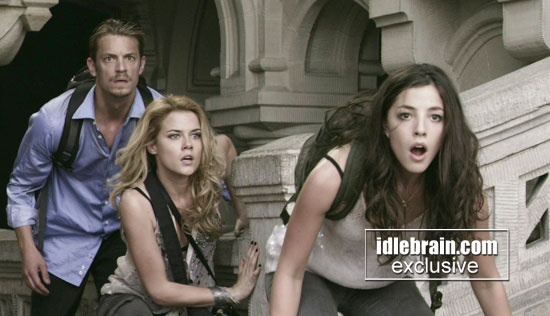
|