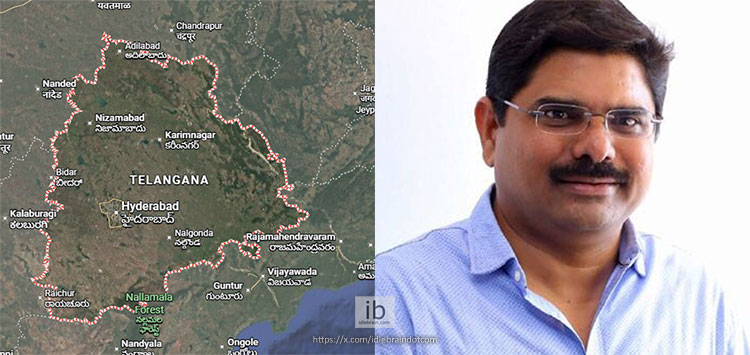
The Telugu film industry has traditionally functioned through a clearly segmented territorial distribution system across Andhra Pradesh, dividing the region into Uttarandhra, East Godavari, West Godavari, Krishna, Guntur, Nellore, and Ceded. This decentralised model has long helped spread financial risk, encourage entrepreneurial participation, and foster lasting exhibitor relationships.
In contrast, the Nizam territory - now the single most influential theatrical market for Telugu cinema - continues to operate as one consolidated distribution unit. Given the dramatic transformation in Telangana’s demographics, urban expansion, and commercial landscape over the past two decades, it is worth examining whether this single-territory structure still reflects present-day realities.
The Economic Weight of Nizam
Trade estimates consistently suggest that Nizam Territory contributes roughly 40–45% of total Telugu theatrical revenues, making it the largest revenue source among all territories. For many major releases, performance in Nizam significantly shapes box-office momentum and market perception.
Recent high-profile films further highlight this dominance. Pre-release business valuations for star-driven projects in Nizam Territory have reportedly reached levels far exceeding individual Andhra territories. In some cases, Nizam rights alone have been valued on par with multiple Andhra areas combined.
Blockbusters such as RRR and Pushpa 2 have reportedly crossed major revenue milestones within Nizam alone, with opening-day and weekend figures from this territory often setting industry benchmarks. Even mid-range commercial films increasingly depend on strong Nizam Territory openings to ensure recovery.
The conclusion is clear: Nizam Territory is no longer just another territory - it has become the central pillar of Telugu theatrical economics.
A Structure Built for a Different Era
Historically, Nizam Territory functioned as a single distribution unit because Hyderabad served as a concentrated exhibition hub. Theatre clusters were limited, releases were fewer, and administrative consolidation was practical.
Today, however, the landscape has changed dramatically:
- Hyderabad has grown into a vast metropolitan economy.
- The Ranga Reddy and surrounding peri-urban belt have expanded rapidly.
- Tier-2 and Tier-3 Telangana towns have developed stronger theatrical circuits.
- Multiplex penetration has increased significantly.
Despite these shifts, the distribution structure has remained unchanged.
Structural Challenges of the Single-Territory Model
1. High Entry Barriers
The financial scale required to acquire Nizam rights restricts participation to a small group of capital-intensive distributors, limiting competitive diversity.
2. Risk Concentration
A single distributor carries enormous financial exposure. In a volatile theatrical environment, this discourages experimentation - especially with content-driven or mid-budget films.
3. Restricted Entrepreneurial Growth
Unlike Andhra’s multi-area model, which allows distributors to scale gradually, Nizam offers limited entry opportunities for newcomers.
4. Operational Disconnect
Managing exhibitor relationships across such a large and diverse geography under one umbrella can result in uneven engagement and oversight.
A Practical Three-Zone Model for Nizam
A balanced restructuring could consider three logical zones aligned with current market realities:
1. Hyderabad Metropolitan Zone: Includes Hyderabad, Ranga Reddy, Medchal–Malkajgiri, and Vikarabad.
This region represents:
- The highest multiplex concentration
- Premium ticket pricing markets
- Maximum opening-day revenue potential
- Dense urban and peri-urban exhibition networks
Hyderabad remains the commercial nerve centre of Nizam, and treating it as a unified metro zone reflects operational reality.
2. North Telangana Zone: Could include Adilabad, Komaram Bheem, Nirmal, Mancherial, Nizamabad, Kamareddy, Karimnagar, Jagtial, Peddapalli, and Rajanna Sircilla.
This belt forms a stable northern exhibition circuit with strong single-screen presence and emerging multiplex growth. Nizamabad could serve as the regional hub.
3. South Telangana Zone: Could include Warangal, Hanamkonda, Mahabubabad, Jangaon, Jayashankar Bhupalpally, Mulugu, Khammam, Bhadradri Kothagudem, Mahabubnagar, Nagarkurnool, Wanaparthy, Narayanpet, Nalgonda, Suryapet, and Yadadri Bhuvanagiri.
This region represents the Warangal–Khammam–Mahabubnagar commercial flow, forming a cohesive southern theatrical circuit. Warangal could function as its hub.
(This zoning model is indicative and open to refinement through industry consultation and trade consensus.)
Potential Long-Term Benefits
Broader Participation
Smaller zones reduce financial thresholds, enabling more distributors to enter the market.
Stronger Theatre Relationships
Localised oversight improves exhibitor engagement and accountability.
Support for Diverse Cinema
Lower risk per zone encourages investment in varied content beyond large-scale star vehicles.
Sustainable Ecosystem Growth
Decentralisation fosters entrepreneurial expansion and builds a more resilient distribution framework.
Strengthening Telangana’s Local Storytelling Ecosystem
Reorganising Nizam distribution could also strengthen Telangana’s indigenous storytelling. Films rooted in local culture, dialect, and lived realities have recently demonstrated strong theatrical potential. Balagam is a striking example - a locally grounded film that reportedly performed on par with much larger commercial productions within Telangana.
This highlights an important insight: when audiences see their own lives authentically reflected on screen, the response is organic and powerful. A three-zone model could allow flexible, region-focused release strategies, enabling Telangana-based filmmakers and culturally rooted narratives to thrive without being constrained by unified territory economics.
Industry Evolution Requires Structural Evolution
Telugu cinema now competes on national and global stages. Market scales have expanded, revenue models have evolved, and audience behaviour has diversified.
When economic scale changes, distribution frameworks must evolve as well.
Reorganising Nizam Territory is not about dividing territory - it is about expanding opportunity, distributing responsibility, and future-proofing Telugu cinema’s theatrical ecosystem.
Cinema thrives when opportunity is distributed, not concentrated. The time has come to reflect that principle in Nizam Territory’s structure.
Madhura Sreedhar Reddy: Author of this article, Madhura Sreedhar Reddy is a Telugu filmmaker who has directed, produced, and distributed films over the past fifteen years. He brings hands-on experience and a deep understanding of both the creative and business dimensions of cinema.